Genoese pesto is a raw sauce made with basil, garlic, pine nuts, Parmigiano, pecorino, extra virgin olive oil, and coarse salt, pounded in a marble mortar with a wooden pestle. It is never cooked or heated: it is thinned with a little pasta cooking water and used to dress pasta. Here you’ll find the traditional recipe with serving sizes for 4 people, step-by-step instructions, the blender version, common mistakes that ruin it, and where to taste it in Liguria.
For those looking for “Ligurian pesto”: it’s the same sauce. The name “Genovese” refers to the city where it originated, and the basil that gives it its distinctive flavor is grown along the Tyrrhenian coast of Liguria, starting with Prà, a neighborhood of Genoa.
- Origin: Genoa; 19th-century Genoese cookbooks
- Total time: 30 minutes, plus the time to cook the pasta
- Servings: 4 (sauce for about 320 g of pasta)
- Difficulty: Medium: It’s all about technique and speed
- Key ingredients: Genoese basil, garlic, pine nuts, Parmigiano, Fiore Sardo, extra virgin olive oil
- When: All year round; fresh basil is at its best in the spring and summer
Ingredients
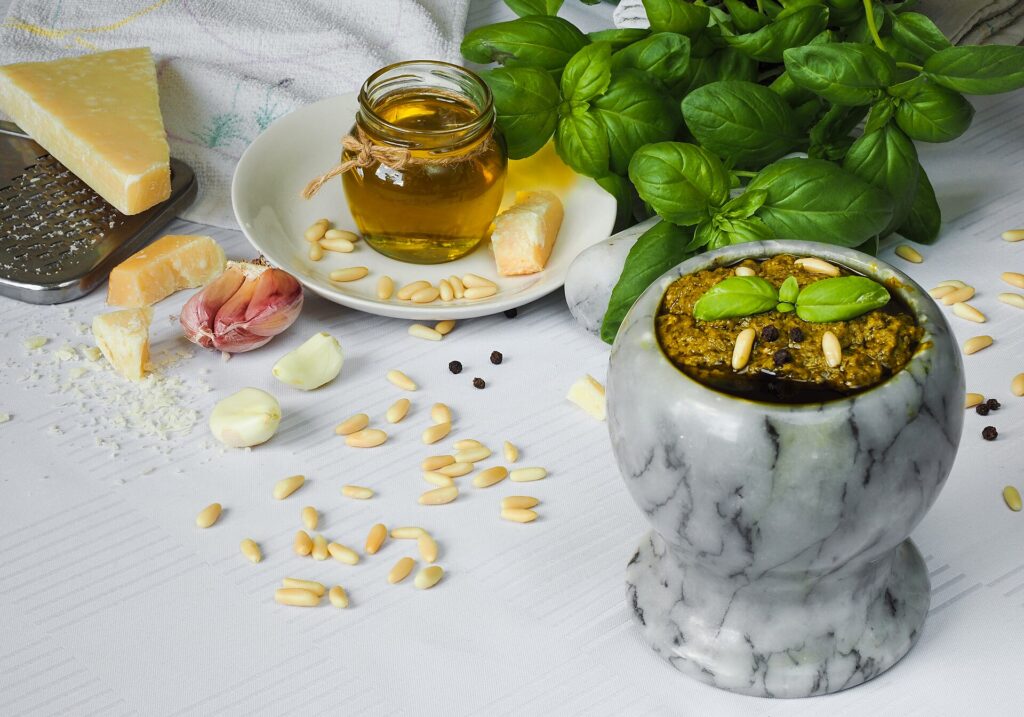
Serves 4. Ligurian recipes vary (some call for much more basil, while others use more oil): these measurements are a conservative guideline—adjust the flavor to your liking. This pesto contains nuts (pine nuts) and dairy products.
- 50 g of Genoese basil leaves (about 60 leaves)
- 2 small garlic cloves, with the germ removed
- 20 g of pine nuts
- 40 g of aged Parmigiano Reggiano
- 20 g of Pecorino Fiore Sardo
- 80 ml of Ligurian extra virgin olive oil
- 2 pinches of coarse salt
- To serve: 320 g of trofie, trenette, or bavette
How to Make It

- Quickly rinse the basil in cold water and pat it dry with a dish towel, without rubbing or crumpling it.
- Grate the two cheeses and mix them together. Peel the garlic and remove the inner germ.
- In the marble mortar, crush the garlic and pine nuts with the pestle using circular motions until you obtain a smooth paste.
- Add a pinch of coarse salt and a sprig of leaves. Gradually add the rest of the basil, stirring in a circular motion against the sides of the bowl.
- Continue until the basil releases a bright green liquid and the mixture becomes a smooth cream, though still slightly grainy.
- Stir in the cheeses, then slowly pour in the oil while stirring. Keep working continuously: the longer the pesto stays under the pestle, the more it oxidizes.
- Cook the pasta in salted water and set aside a few spoonfuls of the cooking water before draining it.
- In a bowl, mix the pesto with 2–3 tablespoons of the pasta cooking water, add the drained pasta (cooked al dente), and toss to combine. Do not heat the pesto on the stove.
With a blender
A blender is faster, but it heats up the leaves and oxidizes them: the result is less green and less fragrant. If you use one, place the blender jar and blades in the freezer for 20 minutes, blend in short bursts of a few seconds (pine nuts, salt, garlic, cheese, and half the oil first, then the basil, then the rest of the oil), and stop frequently. An alternative is to add an ice cube to the blender jar. It should remain slightly grainy, not smooth like store-bought pesto.
Tips and Common Mistakes

- Dried, whole basil. Water left on the leaves dilutes the sauce; leaves that have been rubbed or crushed too hard turn black and develop a bitter taste. It’s best to use small, young leaves.
- Coarse salt helps. It acts as an abrasive and breaks up the leaves: do not substitute it with table salt.
- Hurry up. Every extra minute under the pestle means more oxidation.
- Do not heat it. Heat causes the pesto to turn black. Dilute the sauce with the cooking liquid off the heat, then season it in a bowl.
- Don’t use too much garlic. A pesto with too much garlic overpowers the basil: if you have trouble digesting it, remove the germ.
- Watch out for the jars. Pesto sold in jars often substitutes pine nuts with cashews or walnuts and extra virgin olive oil with seed oils, and may contain citric acid: these are choices made by the manufacturer, not part of the traditional recipe.
- Storage. Store in a sealed jar in the refrigerator for about a week, keeping the surface covered with a thin layer of oil at all times; it can also be frozen in individual portions.
Variants

Pesto is a set of practices rather than a fixed recipe. Here’s what changes—and where.
- Trofie with pesto: the classic pairing. Trofie are a specialty of the Golfo Paradiso region: Recco, Sori (De.Co. since 2019), and Camogli.
- Trenette or bavette with potatoes and green beans: the most common version in the Levante region.
Pasta with Potatoes and Green Beans

Boil 2 medium potatoes, thinly sliced, and 80 g of trimmed green beans in salted water; after about five minutes, when the vegetables are still al dente, add 320 g of trenette or bavette. Drain everything together and toss with the pesto mixed with a few tablespoons of the cooking water: the starch from the potatoes makes the sauce creamy.
- Lasagna with pesto: layers of egg noodles, béchamel sauce, and pesto.
- Genoese-style minestrone: Add a spoonful of pesto at the end of cooking, just before serving.
- Other shapes: potato gnocchi, corzetti, tagliolini, linguine.
- Along with the focaccia: try the Genoese focaccia or the Recco focaccia as well.
- Historical variations: In the inland regions, walnuts were used instead of pine nuts, and in some households in Genoa and Savona, butter was used instead of oil; a 19th-century cookbook suggests using parsley and marjoram when basil is not available.
History and Origins
Pesto traces its origins to ancient sauces pounded in a mortar: examples include the Roman “moretum” described by Virgil and the medieval “agliata” made with garlic and walnuts. The recipe using basil appears in 19th-century Genoese cookbooks: Wikipedia cites Emanuele Rossi’s *Vera cuciniera genovese* (1852) as the first documented reference, while other sources cite Giovanni Battista Ratto’s *La cuciniera genovese*, with different dates (1863, 1865); for this reason, we simply refer to it here as “the 19th century.”
Basil has its own designation: Genovese Basil DOP (EC Regulation 1623/2005), grown on the Tyrrhenian coast of Liguria. It has small, oval, convex leaves and a delicate aroma, without the minty note found in other types of basil. Prà, in Genoa, is the neighborhood most closely associated with this greenhouse cultivation. Pesto itself is neither PDO nor PGI: it is included in the list of traditional agri-food products of Liguria, and the Genoese Pesto Consortium provides a standard recipe with seven ingredients.
Since 2007, Genoa has hosted the World Pesto-Making Championship using a mortar and pestle every two years at the Palazzo Ducale: the eleventh edition took place on March 21, 2026, with 100 competitors.
Where to Try It in Liguria
Pesto is eaten throughout Liguria, but to experience it at its best, you should start in Genoa and the Golfo Paradiso.
- In Genoa: trofie and trenette with pesto are on the menu at many restaurants. To choose the right one, ask if the pesto is homemade, made in a mortar with Genoese basil; it should be a bright green color, and the oil shouldn’t separate. More dining ideas on what to eat in Genoa.
- Prà: the neighborhood of basil greenhouses. The producer Il Pesto di Prà has organized “Serre Aperte” (Open Greenhouses), featuring a tour, pesto-making with a mortar and pestle, and a trofie tasting: the most recent event we found took place on September 27, 2025; there are no dates listed for 2027; reservations must be made by email.
- A class: On the Cesarine platform, there’s a class that lasts about two hours, for up to eight guests, offered in Italian and English, featuring pesto made in a mortar and focaccia. There’s a fee: check the website for dates and prices.
- The Championship: The next edition after 2026 has not yet been announced; see the championship website for more information.
- Golfo Paradiso: Recco, Sori, and Camogli —home of trofie pasta.
For an overview, read the guide to Ligurian cuisine and check out other Ligurian recipes, such as pansoti with walnut sauce.
What to Drink
Ligurian white wines pair well with a dish fragrant with basil and garlic: the fresher Vermentino and the fuller, more savory Pigato, typical of the Ponente region. For more details, see “Ligurian Wines.”
Frequently Asked Questions
Is Genoese pesto a PDO?
No. It is the basil (Basilico Genovese DOP) that has DOP status, not the sauce. Pesto is included in the list of traditional agricultural and food products of Liguria.
What kinds of cheese are used?
Aged Parmigiano Reggiano and pecorino—usually Fiore Sardo—in a ratio of about two to one. Some sources recommend Pecorino Romano.
Can you make it in a blender?
Yes, but the result is different: the blades heat up the leaves and oxidize them. If you do this, cool down the pitcher and the blades, use the pulse setting, and add the basil last along with the oil.
How long does it last?
It will keep for about a week in the refrigerator, in a sealed jar with the surface covered with oil. It can be frozen in individual portions.
Can I substitute the pine nuts?
Yes, with walnuts: it’s a traditional variation from the inland region. However, anyone with a nut allergy should avoid both.
What kind of pasta is it served with?
Serve it with trofie, the classic pasta, or with trenette and bavette (also with potatoes and green beans). Pesto is also used on lasagna, gnocchi, and in Genoese-style minestrone.
Are “Ligurian pesto” and “Genoese pesto” the same thing?
In common usage, yes: they refer to the same sauce made with basil, garlic, pine nuts, cheese, and oil.