Farinata is a thin flatbread made from chickpea flour, water, oil, and salt, cooked in a pan over very high heat: golden and crispy on the outside, soft on the inside. In Liguria, it’s eaten hot, fresh out of the oven, with a sprinkling of freshly ground black pepper. In Genoa, it’s called fainâ. The recipe below is the basic one: three parts water to one part flour, several hours of resting, and plenty of oil.
It has four ingredients, and the result depends on three things: how long the batter rests, the oil, and the oven temperature. At the bottom, you’ll also find regional variations and how they differ from Nice-style socca and Tuscan cecina, which are closely related but not the same thing. For an overview of Ligurian dishes, check out the guide to Ligurian cuisine.
- Origin: Genoa and Liguria; the earliest written record is a Genoese decree from 1447
- Time: about 5½ hours, almost all of which is resting time; 20–25 minutes in the oven
- Servings: 4 (three 32-cm baking pans)
- Difficulty: easy, but it takes patience
- Key ingredients: chickpea flour, water, extra virgin olive oil, salt
- When to eat it: hot, fresh out of the oven, as a snack or appetizer
Ingredients
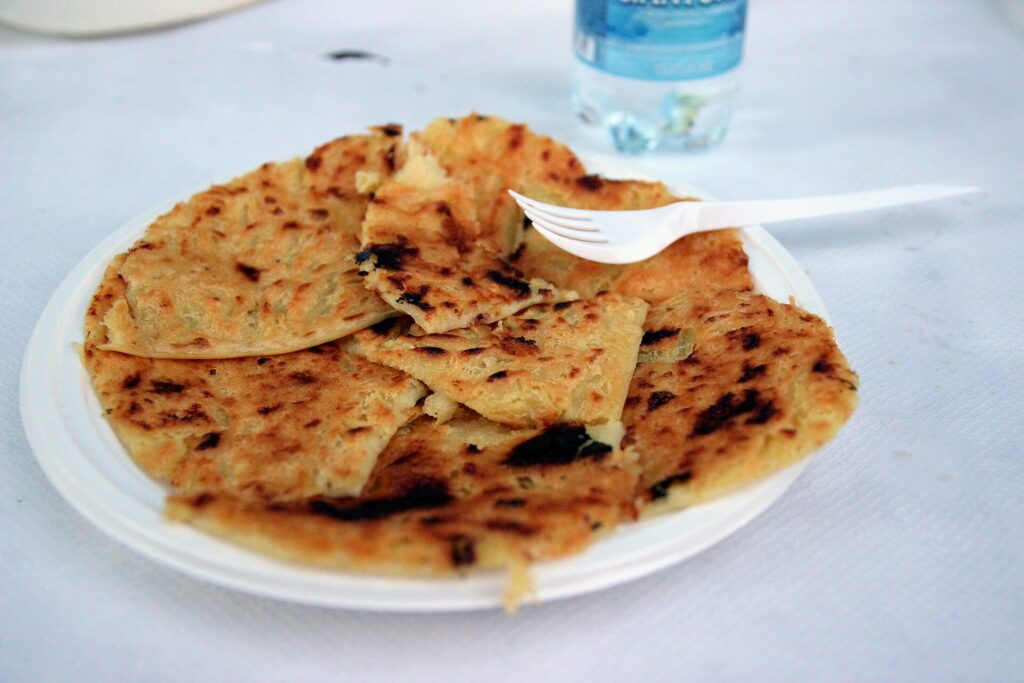
Serves 4; makes about three 32-cm pans.
- 300 g of chickpea flour
- 900 ml of water at room temperature
- 50 ml of extra-virgin olive oil for the batter, plus additional oil for greasing the baking sheets
- 10 g of fine salt
- Freshly ground black pepper, for serving
How to Make It
- Pour the chickpea flour into a large bowl and gradually add the water, stirring with a whisk to prevent lumps from forming.
- Combine the salt and oil, stir, cover, and let sit for 4–5 hours at room temperature (outside the refrigerator), stirring occasionally.
- Use a ladle to skim off the foam that has formed on the surface, then stir again.
- Preheat the oven to the highest setting, 250 °C (conventional), and place the rack on the lowest shelf.
- Grease the pans well, pour the batter in a thin layer, and smooth it out with the back of a ladle or a fork.
- Bake on the lower rack for 10 minutes, then move the baking sheet to the top rack and bake for another 10–15 minutes, until golden brown.
- Sprinkle with black pepper and serve immediately, cut into irregular pieces.
Tips and Common Mistakes
- The report. The most commonly cited ratio is one part flour to three parts water. With less water, the farinata turns out thicker and softer; with more water, it’s thinner and crispier.
- Lumps. Add the water a little at a time and mix with a whisk: once the dough has rested, you can’t fix it anymore.
- A short rest. This is the most common mistake. Sources suggest anywhere from 2–3 hours to 10 hours; 4–5 hours is a good middle ground.
- Leave the foam where it is. If you don’t remove it, it will darken during cooking.
- A little oil. The oil in the baking pan creates a crispy crust and helps the farinata come away from the pan.
- The layer is too thick. It should be only a few millimeters thick; a thicker layer won’t cook properly in the center.
- Convection oven. It can be used at 220 °C: for the first 7–8 minutes on the lower rack, then on the upper rack for another 10–15 minutes.
Variants
The name and details vary from one area to another. The following are the most well-documented.
Genoa: the fainâ
In Genoa, this is the classic version, made with just chickpeas, baked in a wood-fired oven called a “sciamadde,” and served with plenty of pepper.
With spring onions (Imperia and Oneglia)

In western Genoa and in Imperia—especially in Oneglia—the surface is topped with sliced spring onions before baking, and pepper is added after baking.
Savona’s White Farinata

In Savona, white farinata is made with wheat flour instead of chickpeas, and black pepper. It’s thinner and crispier, and light in color. It’s not a variation of the recipe above: the measurements and resting time are different.
La Spezia: Fainà
In La Spezia, it’s called fainà. We haven’t found a confirmed local name for the other towns along the Levante coast.
Socca from Nice, cade from Toulon, and Tuscan cecina

Socca is the farinata of Nice: it has the same base of chickpea flour, water, oil, and salt, is baked in large copper pans in a wood-fired oven, and is seasoned with pepper after baking. Genoa has regulated the trade in chickpea flour since the 15th century, and French sources consider it the descendant of the farinata brought to Nice by Ligurian sailors and merchants. The differences lie more in name and custom than in the recipe: in Nice, it is often thicker, while in Liguria it tends to be thin (about 4 mm), but sources disagree, so this is not a hard-and-fast rule. In Toulon, the similar version is called cade.
In Tuscany, it’s called “cecina” in Pisa, “torta” or “torta di ceci” in Livorno—where it’s served in the “5 e 5” sandwich—and “calda calda ” in Massa and Carrara. In Sardinia, it’s called “fainè.”
If you’re leaving from Nice, the guide on how to get there by train is ” From Nice to Liguria by Train“; the first Ligurian city after the border is Ventimiglia.
History and Origins
Its origin is uncertain. The most widely told story links it to the Battle of Meloria in 1284, won by Genoa over Pisa: a storm is said to have spilled oil and chickpeas onto the ship, and the mixture, left in the sun, is said to have become the first farinata, mockingly called “gold of Pisa.” It is a legend, not a documented fact.
The earliest record is a decree from the Republic of Genoa dating back to 1447 that prohibited the use of poor-quality oil in “scripilita,” the name by which farinata was known at the time. It is believed that Genoa spread the use of chickpeas through its trade. The sciamadda (from the Genoese word “fiammata”) is a shop with an oven that is always lit, where farinata, savory pies, and fried foods are sold.
Where to try it in Liguria

- Genoa: Farinata is served in the sciamadde of the historic center, along with panissa and frisceu; Sottoripa is the historic district known for its fried foods. Find more dishes in the “What to Eat in Genoa” section. Hours vary by restaurant: check the latest information before you go.
- Savona: Where to Find White Farinata.
- Imperia: the version with spring onions, in Oneglia.
- La Spezia: fainà, served on a paper plate and cut into pieces.
- Recco: It’s not farinata, but it’s the home of another baked dish; see Recco focaccia.
For more Ligurian baked recipes: Genoese focaccia, torta pasqualina, and Genoese pesto.
What to Drink
A fresh Ligurian white wine, such as a Vermentino or a Pigato, is a sensible pairing with hot farinata: it is not a pairing dictated by tradition. Overview in the guide to Ligurian wines.
Frequently Asked Questions
What is the difference between farinata, socca, and cecina?
It’s the same basic batter made from chickpea flour, water, oil, and salt. What changes are the name (farinata or fainâ in Liguria, socca in Nice, cecina in Pisa) and the specifics regarding thickness and cooking, which vary from place to place.
How long should the batter rest?
At least 4–5 hours at room temperature, stirring occasionally and skimming off the foam. Sources range from 2–3 hours to as long as 10.
Can I make it without a wood-fired oven?
Yes. At home, I set the oven to its highest temperature—250 °C (conventional)—baking it for 10 minutes on the bottom rack and then 10–15 minutes on the top rack. The result is less smoky than what you get in a wood-fired oven, but it’s still good.
Is farinata gluten-free?
Chickpea farinata does not contain wheat, but if you have celiac disease, make sure the flour is certified gluten-free. Savona-style white farinata is made with wheat flour and contains gluten.
Why is it called “Pisa gold”?
According to the legend of the Battle of Meloria (1284), the name originated as a taunt directed at the defeated Pisans. This story is not documented.
Do you add rosemary?
In the basic Ligurian version, only pepper is served at the table. Some versions include rosemary, but it is not part of the basic recipe.