Corzetti (also known as croxetti in Ligurian and crusètti in Varese Ligure) are a type of fresh Ligurian pasta shaped like thin discs, decorated with a raised pattern using a wooden mold. The design isn’t just beautiful—it creates grooves that hold the sauce. They are the traditional pasta of eastern Liguria.
Note the name: in Val Polcevera, just outside Genoa, “corzetti” refers to a different type of pasta—small and shaped like the number eight—made by hand without a mold. Below you’ll find the recipe for molded corzetti—the one people usually look for under this name—followed by the Val Polcevera version in its various forms.
- Origin: Liguria; printed in the Levante region and in Varese Ligure, in sets of eight in Val Polcevera
- Total time: about 55 minutes, including the time the dough rests
- Servings: 4
- Difficulty: easy, but the molding process requires a little patience
- Key ingredients: flour, egg, white wine; pesto or walnut sauce for serving
- When: year-round
Ingredients

Serves 4
- 300 g of 00 flour
- 1 whole egg
- 50 ml of white wine
- 50 ml of lukewarm water
- A few chopped marjoram leaves (optional)
- Semolina or flour for the baking sheet
- Genoese pesto or walnut sauce, enough to dress the dish
You’ll also need a corzetti mold (two wooden pieces: a concave one that cuts the disc, and a stamp-like one that imprints it). If you don’t have a mold, see the tips.
How to Make It

- Make a well in the flour and crack the egg into the center; beat it lightly with a fork.
- Add the wine and lukewarm water a little at a time, incorporating the flour from the edges; stir in the marjoram if using it.
- Knead until the dough is smooth and soft, shape it into a ball, and cover it.
- Let the dough rest at room temperature for at least 30 minutes.
- Roll out the dough on a floured surface until it is thin—between 1.5 and 2 mm.
- Cut out the discs using the concave side of the mold.
- Press each disc between the two halves of the mold to imprint the design.
- Place the corzetti on a tray dusted with semolina or flour and let them dry for a few minutes.
- Cook them in plenty of salted water for 2–3 minutes, then taste them: if you’ve let them dry for a long time, they’ll need a few more minutes.
- Drain them and toss them immediately with the sauce of your choice.

Tips and Common Mistakes
- A dough that is neither sticky nor floury. If it sticks, add some flour; if it crumbles, add a splash of lukewarm water.
- Thin sheet. If it’s too thick, the pattern gets lost and the disc remains hard in the center.
- Press the dough onto a clean, floured surface and remove any excess flour: the design will smudge on wet dough.
- Don’t cook them for too long: they’re thin discs. The pattern isn’t as visible after boiling, but it helps the sauce cling to them.
- Season it right away. Once cooked and seasoned, they should be eaten right away; if raw, they can be frozen and cooked straight from the freezer.
- If you don’t have a cookie cutter, you can cut out the discs using a pastry ring or a glass and press them with a mold that doesn’t cut: the result is simpler, but the cookies are still good.
Variants
There is no single recipe: sources differ, and every family has its own.
- Stamped corzetti from the Levante region. The ones from the recipe above. In Varese Ligure, the dough contained few eggs, but included butter and Parmesan cheese; in the Oltregiogo region, between Novi Ligure and the surrounding area, white wine was used.
- Corzetti from Val Polcevera. Small, handmade figure-eight-shaped cookies about 1 cm in size: pinch off pieces of dough the size of a chickpea, roll them between your palms, and pinch the center closed with your index finger and thumb. One source calls for 500 g of flour, 3 eggs, and lukewarm water. They’re also called “tiae co e dië,” meaning “pulled with the fingers.”
- Egg-free dough. Just flour and lukewarm water (400 g of flour and 200 ml of water is a common ratio), with a little oil.
- Other dough variations: egg yolks only, butter instead of oil, sparkling water, or boiled potato in the dough. Adding saffron to the dough is a modern choice, not a rule.
Traditional Condiments
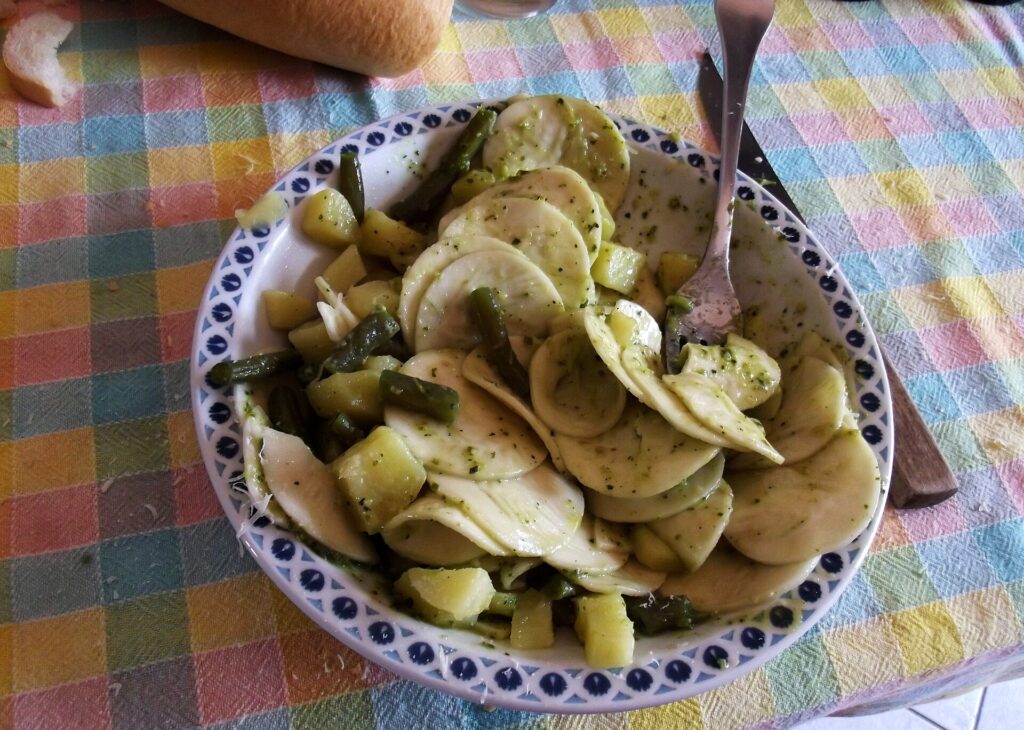
- Genoese pesto: the best known; see our page on Genoese pesto.
- Walnut sauce: the same as for pansoti.
- Pine nut sauce (common in the Levant) and marjoram and pine nut pesto.
- Mushroom sauce (tocco de funzi) and a touch of meat, white or red.
- Butter and sage, for those who want the flavor to take center stage.
History and Origins
Its origin is a matter of debate. The name may derive from “crocetta,” the small cross that often adorned the coin, or from “corzetto,” a Genoese coin from the 14th century; these are different explanations, and none is certain.
A similar pasta dish appears as early as the Middle Ages: the *Liber de coquina*, an anonymous 14th-century treatise, mentions Provençal *crosets *. According to Pietro Picetti, a document from the Genoa State Archives dating from 1362 lists them among the expenses for an official banquet for Moroccan ambassadors.
In noble families, molds bearing the family crest were carved; these were passed down through the generations and sometimes given as part of a dowry. Kitchen molds were made of non-tannic hardwood (pear, apple, beech, olive). In Varese Ligure, there is still a workshop that carves them by hand.
Where to Try Them in Liguria
Stamped corzetti are a dish from the eastern Ligurian coast and the La Spezia hinterland. Good places to find them include Genoa, Chiavari, and Sestri Levante, as well as La Spezia, with Varese Ligure just beyond it. We won’t mention specific restaurants because we haven’t verified an up-to-date list: just ask at a trattoria that cooks in the traditional style if they make them in-house.
For the corzetti of Val Polcevera, the starting point is Genoa: on the “What to Eat in Genoa” page, you’ll find an overview of the city’s cuisine. For the rest of the regional cuisine, see “Ligurian Cuisine,” which features other pasta dishes such as mandilli de sea and testaroli.
What to Drink
Fresh white wines from Liguria, such as Vermentino, pair well with pesto or walnut sauce: you can find them in the guide to Ligurian wines.
Frequently Asked Questions
Which is it: “corzetti” or “croxetti”?
They are the same type of pasta. “Croxetti” is the Ligurian spelling, “corzetti” the Italian one; in Varese Ligure, they are also called “crusètti.”
What is the difference between stamped corzetti and Val Polcevera corzetti?
The first are thin discs with a raised design, made using a wooden mold. The second are small pieces of dough shaped like the number eight, about 1 cm long, made by hand without a mold.
Can I make them without a mold?
Yes: Cut out the circles using a cookie cutter or a glass. If you want a pattern, you can press a coin or a non-cutting stencil on top, but it’s not the same thing.
What do you serve them with?
With Genoese pesto, walnut or pine nut sauce, mushroom sauce, a touch of meat, or simply butter and sage.
Are eggs required?
No: Sources provide versions with one egg, just egg yolks, or no eggs at all (flour and water). This recipe uses one egg and white wine.
Can I freeze them?
They can be eaten raw, and you can cook them straight from the freezer. Once cooked and seasoned, they should be eaten right away.
Where can you buy a mold?
Wooden molds can be found in Ligurian artisan shops (there’s one in Varese Ligure) and in kitchenware stores; make sure the wood is hard and doesn’t contain tannins.