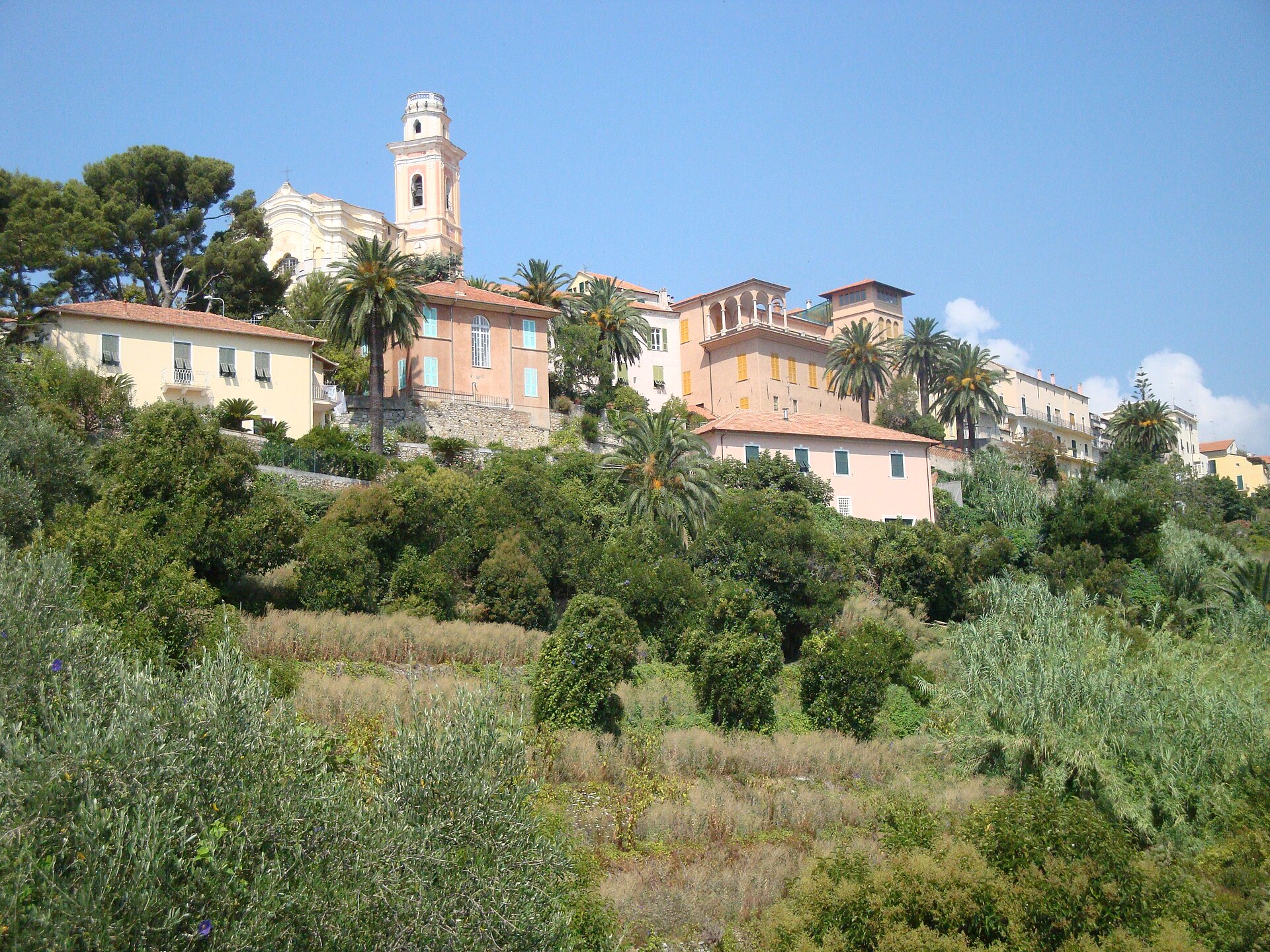
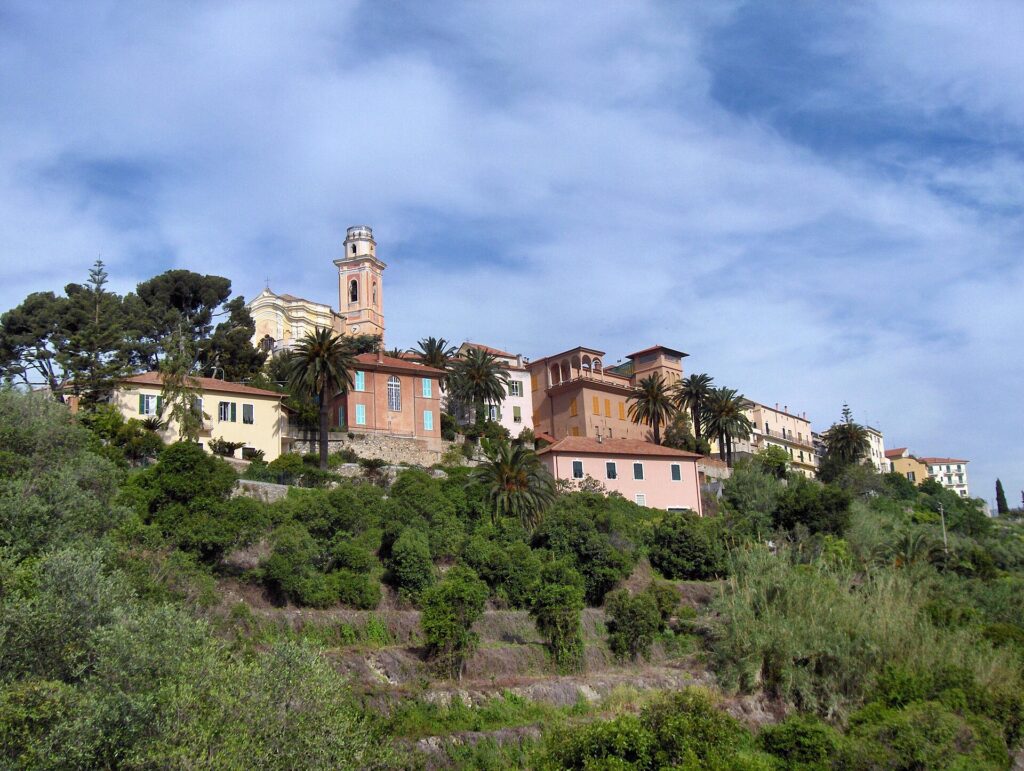
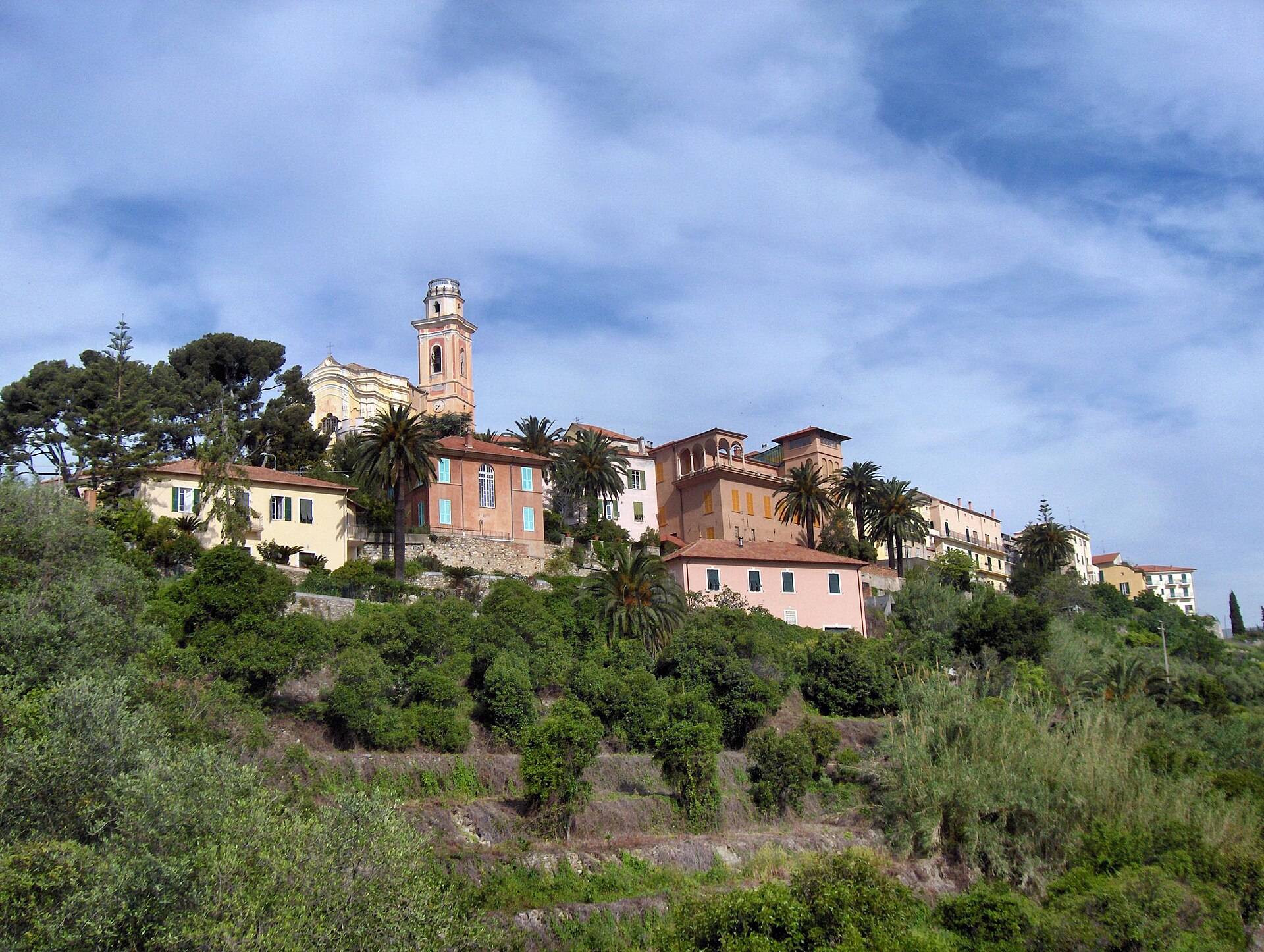
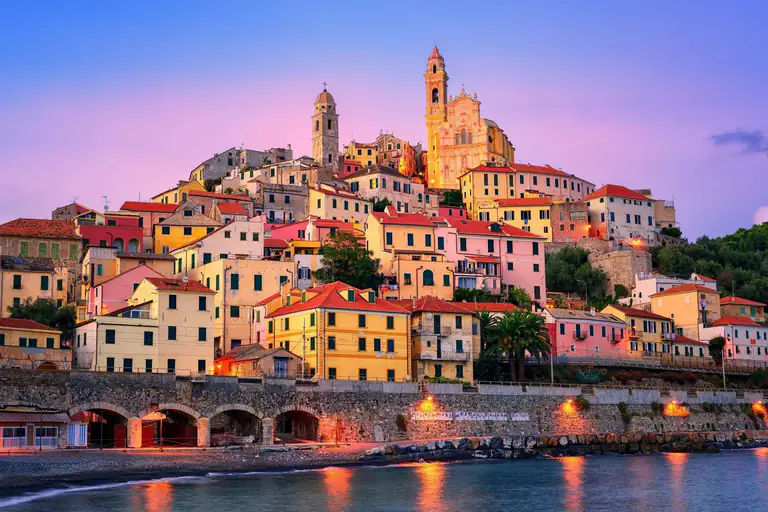
Diano Castello is a fortified hill village at 135 metres above sea level, just inland from Diano Marina. As the crow flies the sea is a little over two kilometres away, but the village sits among olive trees and vineyards and feels like a different place. It has about 2,250 inhabitants, a compact old town you can walk in a couple of hours, and a handful of Romanesque and Baroque churches rarely found together in so small a space. It is one of Italy’s Borghi più belli d’Italia and holds the Touring Club’s Orange Flag (Bandiera Arancione).
The Latin name was Castrum Diani. The village was built around the 10th century as a defence against Saracen pirate raids and appears in a document of 1033. It passed to the Clavesana marquises, was already a free commune in 1172, then came under Genoa, and in 1284 sent men and a galley to the Battle of Meloria. It was the capital of the Communitas Diani, the union of the villages of the Diano valley: the coats of arms of those communes can still be seen on the loggia at the entrance to the village.
People come to wander between lanes, arches and stone steps, to see the churches and to find the Lone, the medieval cisterns under the old town. It is a half-day stop, easy to combine with the beach at Diano Marina, Cervo and Imperia. The Castrum Diani medieval festival is in early September and the Premio Vermentino wine event is in July; the rest of the year the village is quiet, with few tourist services. Our guide to the old town, churches and Lone goes through everything you can see, building by building.
By Italian Riviera editorial team·Updated on ·10 min read
Where is Diano Castello?
Diano Castello is in Liguria (Riviera di Ponente, Riviera dei Fiori, province of IM).
The old town is small. From the entrance to the upper part takes only a few minutes, but with stops you need about two hours. The streets climb and are paved with cobbles and setts, so wear comfortable shoes. The stops below follow a walking route, from the loggia towards the churches.
The municipal loggia
The loggia is the symbol of the village and the first thing you meet on entering. Under the arches are painted the coats of arms of the communes that made up the Communitas Diani. We could not find a confirmed date of construction, so we do not give one. It is the handiest place to start your visit.
Piazza Matteotti and the parish church of San Nicola di Bari
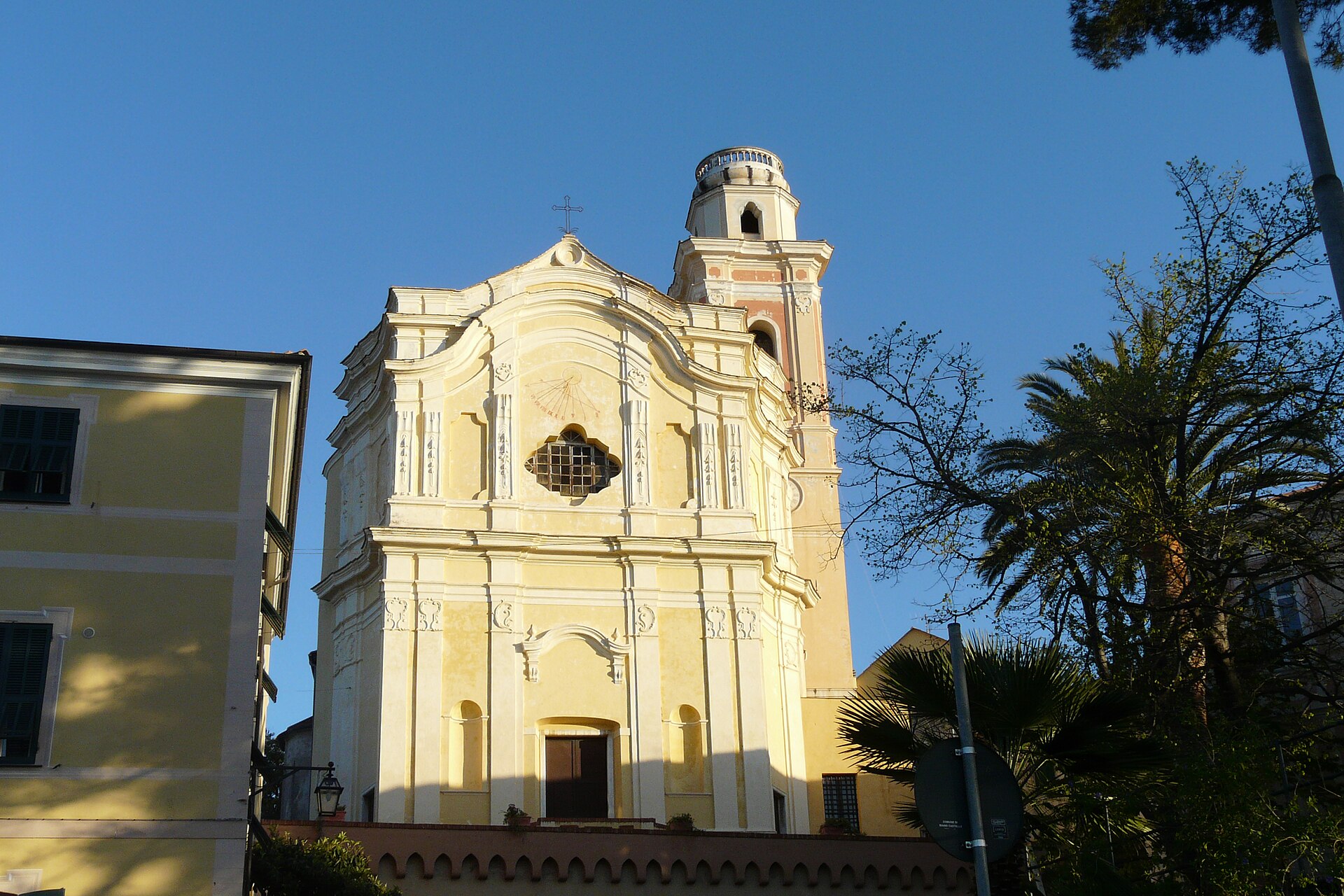
From the loggia you reach Piazza Matteotti, with the parish church of San Nicola di Bari. The church is Baroque and was rebuilt between 1699 and 1725 by the Marvaldi family. Inside you will see marble altars, a wooden Crucifix attributed to Anton Maria Maragliano and an 18th-century wooden choir. The church has no dome and the bell tower ends in a circular terrace; according to the regional tourist board this is a result of damage from the 1887 earthquake. The patron saint is St Nicholas, celebrated on 6 December.
Palazzo Quaglia and the town hall
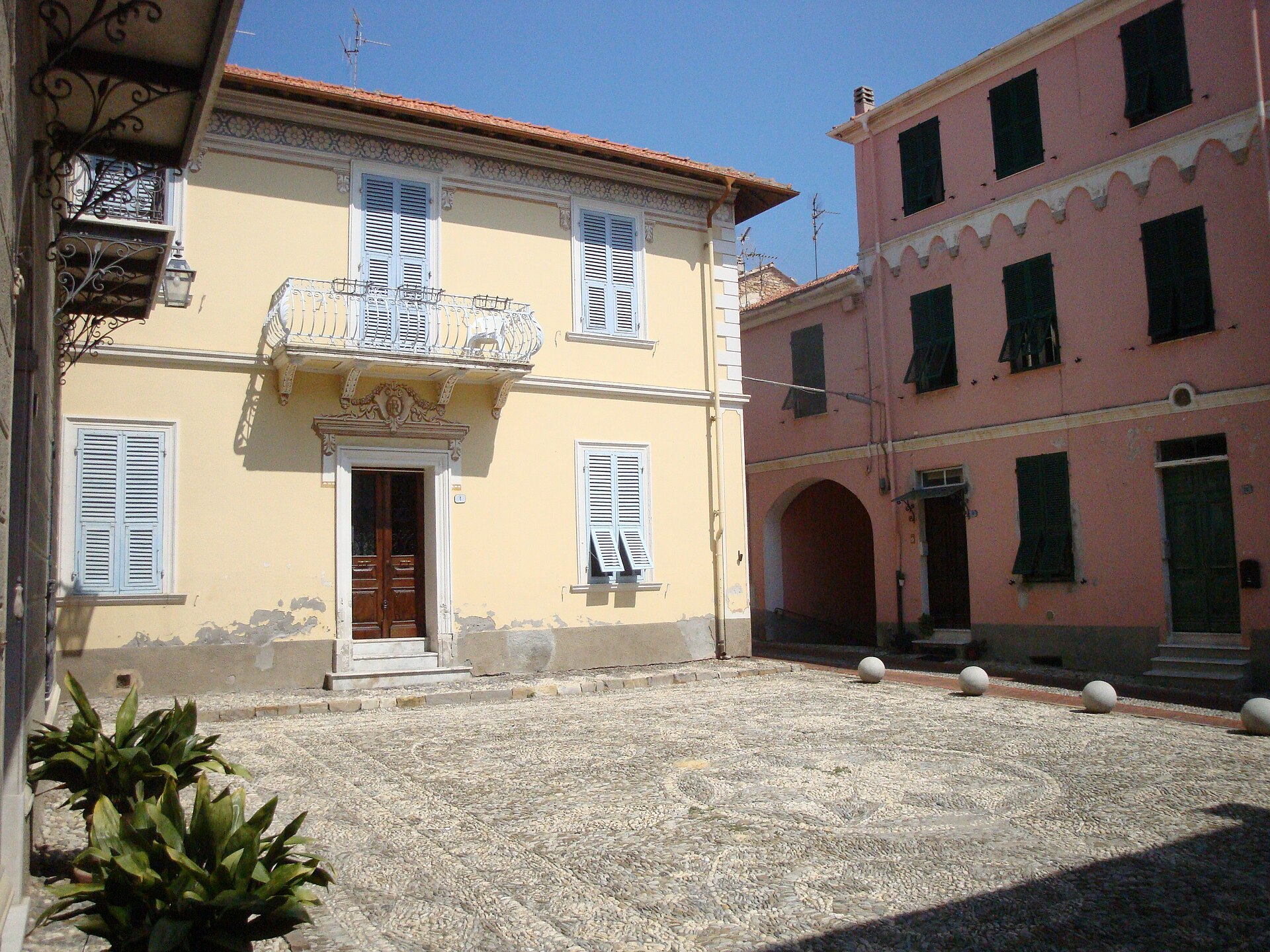
The town hall is a 15th-century building, once the residence of the Quaglia counts. It includes a crenellated tower and on its façade has a large 17th-century fresco commemorating the Battle of Meloria. It houses the municipal offices, so you look at it from outside. From the town hall square the view opens over the hills and over the pebble mosaics, with designs of flowers, stars and spirals.
Piazza Clavesana and the castle remains
Piazza Clavesana is the old feudal seat of the Clavesana marquises, the lords of the village before Genoa. Nearby are the remains of their castle. We have no reliable description of what exactly survives, so expect something to look at rather than to visit. The lanes towards the gates start here.
The walls and the four gates
The town walls are mostly gone, but their line can still be guessed. There were four gates: Porta della Marina, Porta del Borgo, Portello di San Pietro and Porta del Mercato. One of the towers survives and has been turned into a house. Some ceramic panels on the village walls show the gates and a plan of the old town: they help you find your way.
The Lone, medieval cisterns
The Lone are underground cisterns dug into the subsoil like great galleries, where rainwater was collected: they served as a reserve in times of drought, danger and siege. The public ones are in the old town, and the openings at surface level can be seen from squares and streets. They can be visited only with a guide. We have not confirmed how to book, when or at what price: ask at the tourist information office (IAT) in via Meloria before you go up. Do not expect to go in on your own.
Santa Maria Assunta
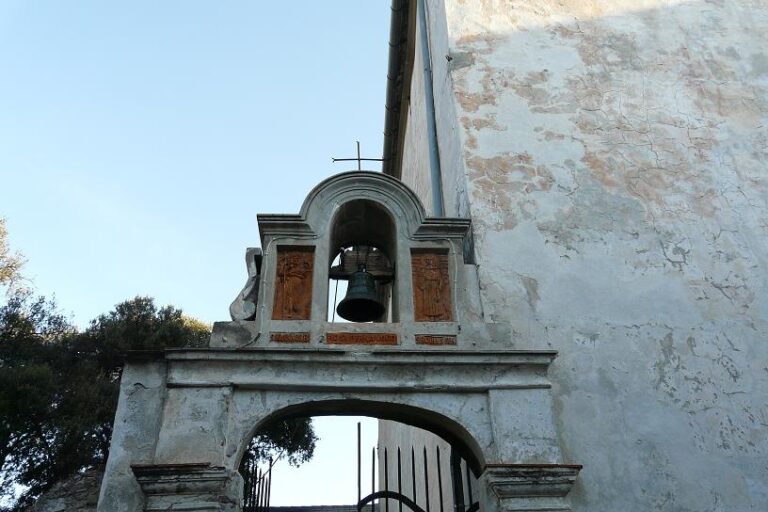
This is one of the village’s two Romanesque churches. According to the official Italia.it page it dates from the 13th century; local sources vary, so take the century with caution. The apse with hanging arches is easy to see from outside, and the bell tower is Baroque and later. Inside are medieval frescoes, partly restored recently. We have no confirmed opening hours.
San Giovanni Battista
It stands just outside the walls. Its origins go back to around the year 1000 and it was altered in the 12th century; it had three apses, but a wing and an apse were demolished in the 19th century to make room for the carriage road. Inside is a timber-trussed roof with 15th-century decoration. Opening hours are not confirmed here either.
Santa Maria degli Angeli and the Franciscan convent
Santa Maria degli Angeli is in the old town, next to the 16th-century Franciscan convent, which has a cloister with a well. The convent holds an altarpiece of St Peter of Alcantara by Giovanni Battista Carlone. Do not confuse this church with Santa Maria Assunta: some online guides mix them up.
The oratory of San Bernardino and Santa Croce
The oratory has late medieval origins and was largely rebuilt in the 17th century. It holds an Annunciation attributed to the Biazaci brothers from Busca. It is one of the smallest churches in the village, a short but worthwhile stop. For the oratories of the Immaculate Conception and San Mauro, with starry ceilings, and for the Madonna della Neve church in the countryside, the regional tourist board page is the only source: if you want to look for them, ask the information office for directions.
The Teatro della Concordia
This is a small theatre in the village where performances are held. We have no confirmed programme or address: if you are interested, ask the town hall. Do not confuse it with the Teatro della Concordia in Monte Castello di Vibio, in Umbria, which is a different building.
Where to stay
Where to stay in Diano Castello
Choice in the village itself is limited. We have not verified hotel names: there are a few farm stays around, according to aggregators, but none is confirmed by official sources. The most practical choice for sea and services is to sleep in Diano Marina, a few minutes away, and come up for the day. If you want quiet and olive groves, look for a house or farm stay in the hills above the village; you will need a car. The old town is traffic-free: steps and slopes are not ideal with heavy suitcases.
If you want an idea of the types of accommodation and nearby areas, our page on the Riviera dei Fiori is a good starting point.
A10, San Bartolomeo al Mare exit, then SP 37 inland: a few kilometres ⚠️
By train
No station: the «Diano» stop (Diano San Pietro) on the Genoa–Ventimiglia line, then bus or taxi ⚠️
By plane
Genoa, about 105 km; Nice Côte d'Azur, about 100 km ⚠️
By car
Leave the A10 at San Bartolomeo al Mare, the exit for Diano Marina, and head inland: the village is on provincial road 37, which runs through the centre and links Diano Marina with Diano Arentino. Imperia is about 5 km away, Genoa about 105 km (estimate) and Nice about 100 km (estimate).
By train
Diano Castello has no station of its own. The nearest stop is “Diano” on the Genoa–Ventimiglia line, opened in December 2016: it is in Diano San Pietro, on the boundary of three municipalities, and outside the centre of Diano Marina. We have no confirmed distance to the village, and there is a Riviera Trasporti shuttle to the centre of Diano Marina. From there you need a bus, a taxi or a car.
By bus
We could not find public timetables for a regular bus between Diano Marina and Diano Castello. Check current times on the Riviera Trasporti website or ask the information office before you travel.
By air
The most convenient airport by distance is Genoa, about 105 km away (estimate). Nice Côte d’Azur is about 100 km away (estimate) and may suit travellers arriving from France.
Parking
The old town is small and narrow: leave the car at the edge of the village and continue on foot. We have no verified spaces, hours or fees. Ask the information office at via Meloria 2.
The hills around the village are covered with olive trees and vines. The vines give Vermentino, the white wine that earns the village its nickname “cradle of Vermentino”; the olives give extra virgin oil, which in this area falls under the Riviera Ligure PDO, Riviera dei Fiori sub-zone, from the Taggiasca cultivar. We could not find a verified olive mill or winery in Diano Castello, nor regularly organised tastings, so we do not name any. If you want to buy oil and wine, ask the IAT or come for the Premio Vermentino.
For local food, see our page on Ligurian cuisine and the one on Ligurian wines. We have not verified restaurant names in the village, and we do not invent them.
Events in Diano Castello
Castrum Diani: the medieval festival, held since 1983, in early September. In 2026 it ran on 4 and 5 September, from 6 pm to 11:30 pm, with a historical procession around 8 pm, duels, flag-wavers, musicians, stilt-walkers and a medieval market. The squares involved are Clavesana, Giudice, De Foresta and Matteotti, with food stands by the Amici del Castello in Piazza Matteotti. In past editions there has been a shuttle from Diano Marina. Dates for next year still need confirming.
Premio Vermentino: founded in 1994, held in July. In 2026 the 33rd edition ran on 11 and 12 July, with tastings, shows and a free guided tour of the village (booking required), plus a free shuttle from Piazza Taramasco.
Other events: the Corpus Domini flower carpets (Infiorata), the Nativity scenes exhibition at Christmas and Halloween. We have no confirmed dates.
Walks and hikes
The best walk is through the old town: lanes with arches and narrow tunnels, cobbles, dry-stone walls with olive trees. For a longer outing you can climb through the olive groves towards the hill: cyclists also use the roads above the village, a climb on tarmac with moderate gradients towards Colla. We have no verified waymarked routes, so ask the IAT or look at our page on trekking in Liguria before you set off.
When to go to Diano Castello
Spring and autumn are the most comfortable seasons, with clear air and mild temperatures. In summer the climb is felt and the sea is a few minutes away: go early in the morning or in the evening. The medieval festival is in early September and the Premio Vermentino in July. In winter the village is almost empty and the churches may be closed. For forecasts and climate see our page on the weather in Diano Castello.
Day trips from Diano Castello
Distances are approximate, not official timetables.
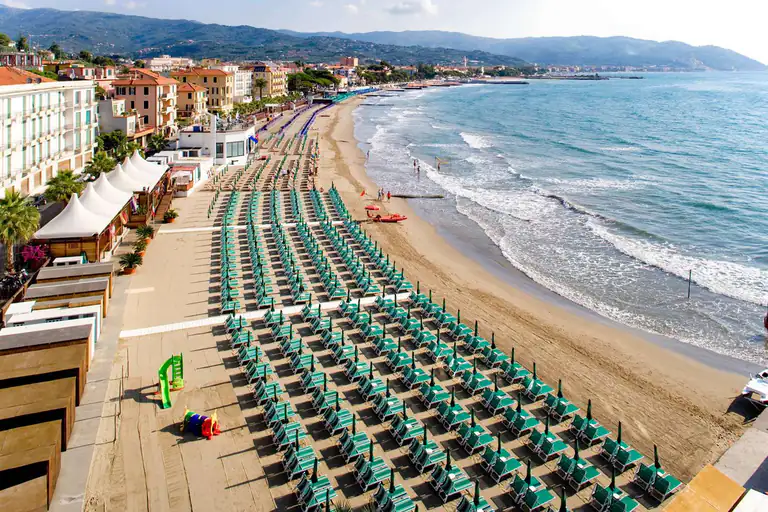
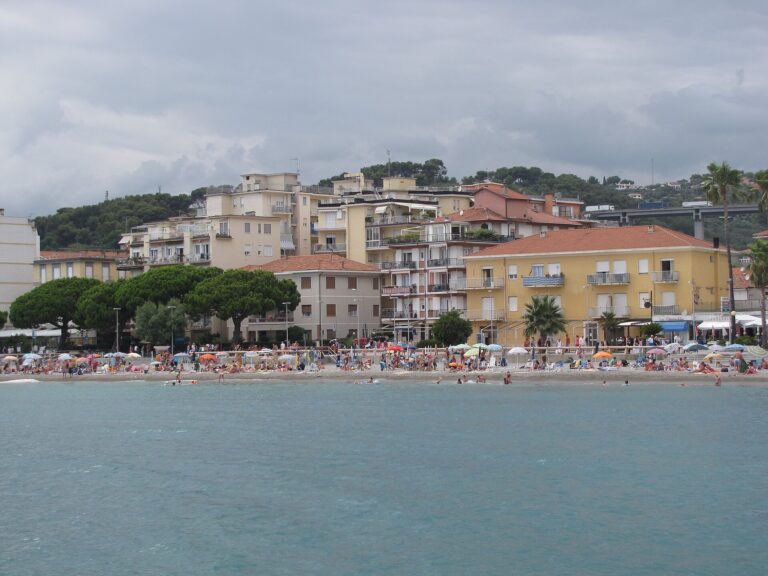
Diano Marina: a little over two kilometres as the crow flies. Sea, promenade, beach and the nearest town with services.
Cervo: a few kilometres east. A medieval village on the sea with the Corallini church and the chamber music festival.
San Bartolomeo al Mare: on the coast to the east. The cycle path on the old railway line.
Imperia: about 5 km. Porto Maurizio, Oneglia and the villas.
Andora: further east on the coast, for the sea and the medieval village of Andora Castello.
Diano Castello con il campanile sulla collinaVista generale di Diano Castello con la chiesa di San Nicola di BariLa torre merlata e le arcate nel centro di Diano CastelloPiazza Clavesana, antica sede feudale dei marchesi di ClavesanaVista dalla piazza del municipio di Diano Castello verso le collineLa facciata della parrocchiale di San Nicola di Bari a Diano CastelloL'abside romanica della chiesa di Santa Maria Assunta a Diano Castello
FAQ
Frequently asked questions about Diano Castello
Does Diano Castello have a beach?
No: it is a hill village. The nearest beach is at Diano Marina, a little over two kilometres away as the crow flies.
How long do you need to visit Diano Castello?
Two or three hours for the old town and the churches from outside; half a day if you add a guided visit to the Lone, if confirmed.
What are the Lone?
They are medieval underground cisterns where rainwater was collected, used in times of drought, danger and siege. They can be visited only with a guide.
How do you book a visit to the Lone?
We have no confirmed procedure. Ask the tourist information office (IAT) at via Meloria 2.
Are the churches open?
We have no confirmed opening hours. The churches may be closed outside service times: ask first.
When is the medieval festival?
Castrum Diani takes place in early September and has since 1983. In 2026 it was on 4 and 5 September. Dates for next year are not yet confirmed.
When is the Premio Vermentino?
In July: in 2026 the 33rd edition took place on 11 and 12 July, with tastings and shows.
Can you get there without a car?
Yes, but with a few steps: by train to the Diano stop, then bus, taxi or shuttle. We have no confirmed bus times to the village.
Is Diano Castello one of Italy's most beautiful villages?
Yes, it belongs to the association, and it also holds the Touring Club’s Orange Flag. The years of award are not confirmed.
Where is the best place to stay?
For sea and services, Diano Marina; for quiet and olive groves, a house or farm stay in the hills, with a car.