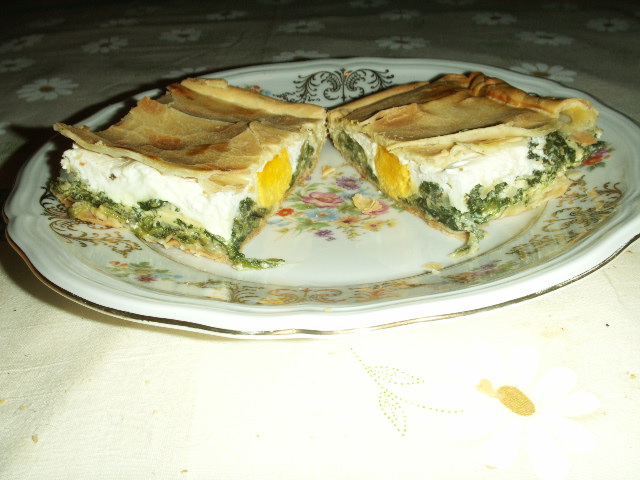
Torta pasqualina is the savoury Easter pie of Genoa: paper-thin layers of pastry, a filling of chard and prescinsêua (a mildly sour Ligurian curd) and whole eggs that turn up hard-boiled when you cut it. It is eaten warm or cold, at Easter and above all on the Easter Monday picnic.
Here you will find the traditional recipe with quantities, how many sheets you really need (tradition says 33, modern recipes use far fewer), what changes in the quick versions and where to try it in Liguria.
- Origin: Genoa and its surroundings; first written mention in the 16th century
- Total time: about 2.5 hours with few sheets, longer with many (estimate); 50 minutes baking
- Servings: 6–8 slices, 26–28 cm tin
- Difficulty: medium: the work is in rolling the sheets
- Key ingredients: chard, prescinsêua, whole eggs, marjoram, extra virgin olive oil
- When it is eaten: Easter Sunday and Easter Monday (in 2027: 28 and 29 March); today available all year
Ingredients
Quantities are for a 26–28 cm tin (6–8 slices) and follow the recipe published by Visit Genoa, Genoa’s official tourist site, which does not give the tin size, so adjust to other recipes. A pasqualina is made whole: for 4 people you will have slices left, and it is even better the next day. Quantities vary from family to family.
For the pastry
- 500 g flour
- 2 tablespoons extra virgin olive oil
- 2 pinches of salt
- lukewarm water as needed for a soft, smooth dough
For the filling
- 1 kg chard (bietoline, the small tender kind)
- 1 onion
- 2 garlic cloves
- 400 g prescinsêua (or dry cow’s milk ricotta)
- 100 g grated Parmigiano (80 g in the chard, 20 g in the prescinsêua)
- 2 tablespoons flour
- chopped fresh marjoram, to taste
- extra virgin olive oil, salt and pepper, to taste
For the eggs
- 8 eggs in all: 2 for the chard filling and 6 whole ones to break into the hollows
How to make it
- Knead flour, oil, salt and lukewarm water into a soft, smooth dough. Divide it into 33 small balls, dust them with flour, cover with a damp cloth and let them rest.
- Clean the chard, boil it in very little water, drain, squeeze it well and chop it.
- Fry the chopped onion and garlic in oil in a pan, add the chard and cook for 10 minutes. Tip into a large bowl and mix with 2 eggs, 80 g Parmigiano and the marjoram.
- Drain the prescinsêua well and mix it with 2 tablespoons flour, 2 tablespoons oil and 20 g Parmigiano; season with salt and pepper.
- Roll out 13 balls one at a time with a rolling pin, as thin as you can, then stretch them thinner with oiled hands until almost transparent. Oil the bottom of the tin and lay the 13 sheets one on top of the other, brushing each with oil except the last.
- Spread the chard over the last sheet and cover it with the prescinsêua. With a spoon make 6 hollows and break an egg into each, lightly salted.
- Roll out the other 20 balls the same way and lay them on the filling, oiled on both sides, trying to keep them apart: blow a little air between the layers with a straw.
- Press the edges together, roll them into a rim and brush the top with oil.
- Bake in a preheated oven at 180–200 °C (about 350–400 °F) for about 50 minutes, until golden with a crisp rim. The yolks of the whole eggs must be firm.
- Let it cool a little before cutting: it is eaten warm or cold.
Tips and common mistakes

- Dry chard. Boil it in little water and squeeze it well: water in the filling soaks the bottom sheets.
- Well-drained prescinsêua. If you buy fresh curd, let the whey drain off: old texts wanted it very dry.
- Almost transparent sheets. The dough is just flour, water and oil, no yeast: rolled thin and oiled between layers, it puffs into a light dome in the oven.
- Deep hollows for the eggs. Make them with a spoon, break the eggs without piercing the yolks and salt lightly: they stay in the centre and show when you cut.
- Well-sealed edges. Seal the rim, or the filling escapes while baking.
- Egg safety. Bake until the yolks are firm; if young children, pregnant women, older people or anyone with a weak immune system will eat it, do not serve it with runny yolks. Keep it in the fridge and do not leave it out for hours, especially in summer.
- Allergens. It contains gluten, eggs and milk.
- Making it ahead. It keeps in the fridge for a few days. To reheat, an electric oven at 100 °C for 5 minutes works better than a microwave (advice from Caseificio Val d’Aveto).
Variations
There is no single «right» torta: sources differ on sheets, cheese and vegetables. These are the variations you really find.
- Torta cappuccina. Same ingredients, but mixed together instead of in separate layers (greens, prescinsêua, eggs): some sources keep the name «pasqualina» for the layered version only.
- With artichokes. Thinly sliced artichokes fried in oil and onion replace the chard outside Easter or by choice; tradition says that at Easter artichokes were too expensive and chard was within everyone’s reach.
- With ricotta. The most common substitute for prescinsêua, which is hard to find outside Liguria: choose a dry ricotta.
- Wild herbs in Ventimiglia. Instead of chard they use wild greens such as caccialepre, nettle and corn salad (songino).
- More vegetables. Some cooks combine spinach and chard, or add dried mushrooms: these are family variations.
- Quick versions. Ready-made puff or shortcrust pastry and few sheets save time, but it is a different pie: buttery, heavier, without the dome of thin sheets.
History and origin

The pasqualina is documented from the 16th century: Ortensio Lando mentions it in his «Catalogo delli inventori delle cose che si mangiano et si bevano» under the name gattafura. Today’s name comes from Pasqua, Easter: eggs and cheese were foods for special occasions, and whole eggs in the filling symbolise rebirth.
The sheets are the legend: housewives are said to have stacked 33, one for each year of Christ’s life. In the 19th century Giovanni Battista Ratto’s «La cuciniera genovese» calls for 27, and in 1930 Giovanni Ansaldo recalled pies of 16 to 24 sheets. At home today far fewer are enough: recipes range from 2 to 33.
Many families once had no oven and took the pie to the baker: to recognise it, they cut a family mark into the rim.
Where to try it in Liguria
Torta pasqualina is found in bakeries, rotisseries and sciamadde (traditional snack shops) in Genoa, all year round and not only at Easter. To understand the rest of Genoese food read what to eat in Genoa and the guide to Ligurian cuisine.
In Ventimiglia look for the version with wild herbs. In 2027 Easter falls on 28 March and Easter Monday on 29 March. On Easter Monday the pie is the queen of the picnic basket, because it is good cold, often the day after it was baked.
Other dishes found in the same places: farinata, pesto genovese and, for the holidays, cappon magro.
What to drink
Pasqualina goes with a young, fragrant, savoury Ligurian white such as Vermentino, served at about 10 °C. More ideas on the page about Ligurian wines.
Frequently asked questions
How many sheets does torta pasqualina have?
Tradition says 33, for the years of Christ. In the 19th century Ratto called for 27. Today recipes range from 2 to 33: more sheets make a lighter pie but a lot more work.
Can I use ricotta instead of prescinsêua?
Yes, it is the most common substitute. Prescinsêua is more sour and lighter, like thick yogurt; with ricotta choose a dry one and drain it well.
Are the eggs raw or hard-boiled?
They are broken raw into hollows in the filling and cook in the pie until firm. Check that the yolks are firm before serving, especially for children, pregnant women or vulnerable people.
Chard or artichokes?
The traditional pasqualina is made with chard: at Easter artichokes were not cheap. Artichokes are for out-of-season versions or for variety.
When is torta pasqualina eaten?
At Easter and on Easter Monday, often cold on the Monday picnic. Today it is available in Genoa all year. In 2027 Easter is on 28 March.
Can I make it the day before?
Yes: warm or cold it is good, and many Genoese prefer it the next day. Keep it in the fridge and reheat in the oven, not the microwave.
What is the difference between pasqualina and cappuccina?
In the pasqualina greens, prescinsêua and eggs sit in separate layers; in the cappuccina they are mixed together.