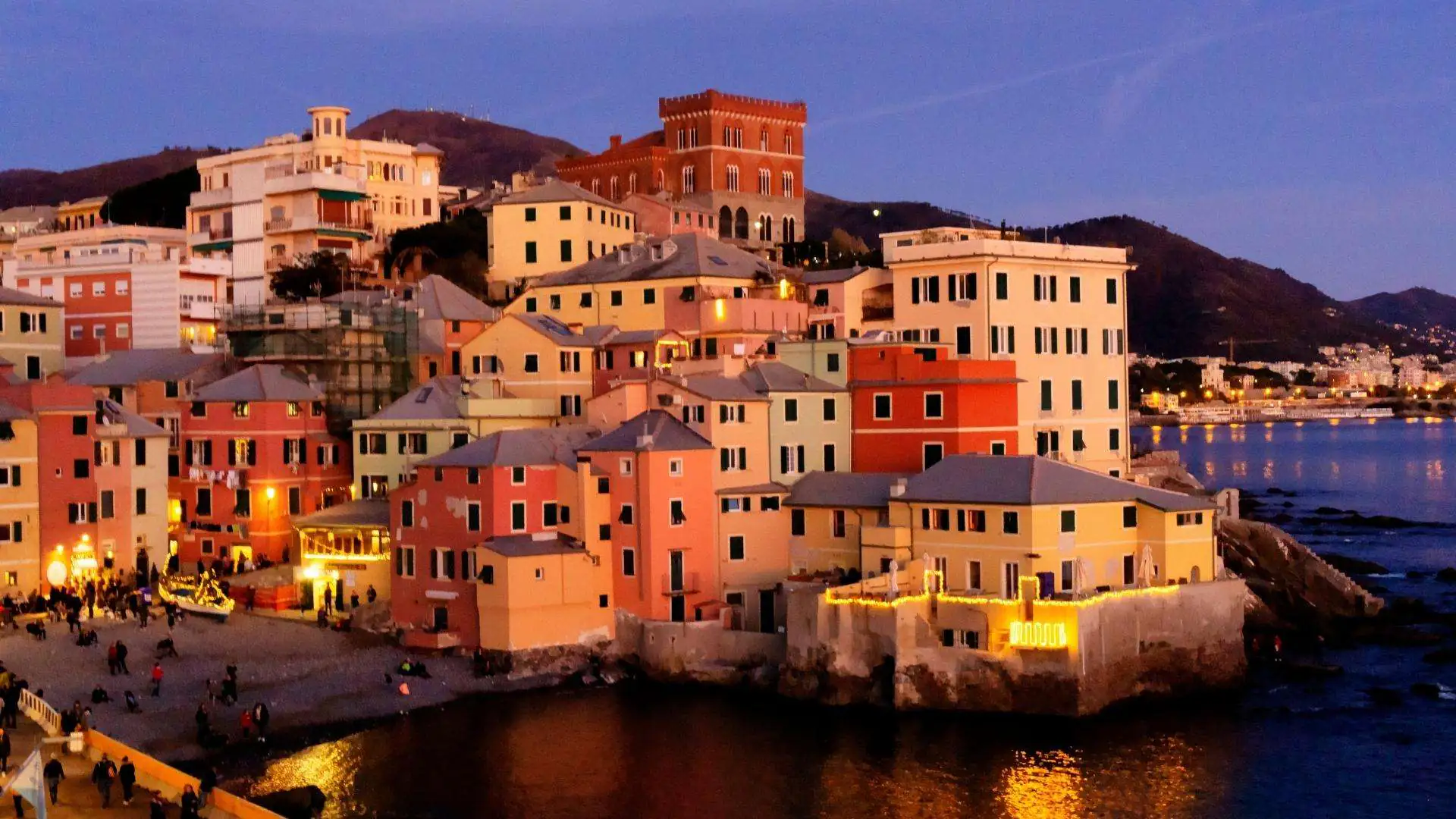
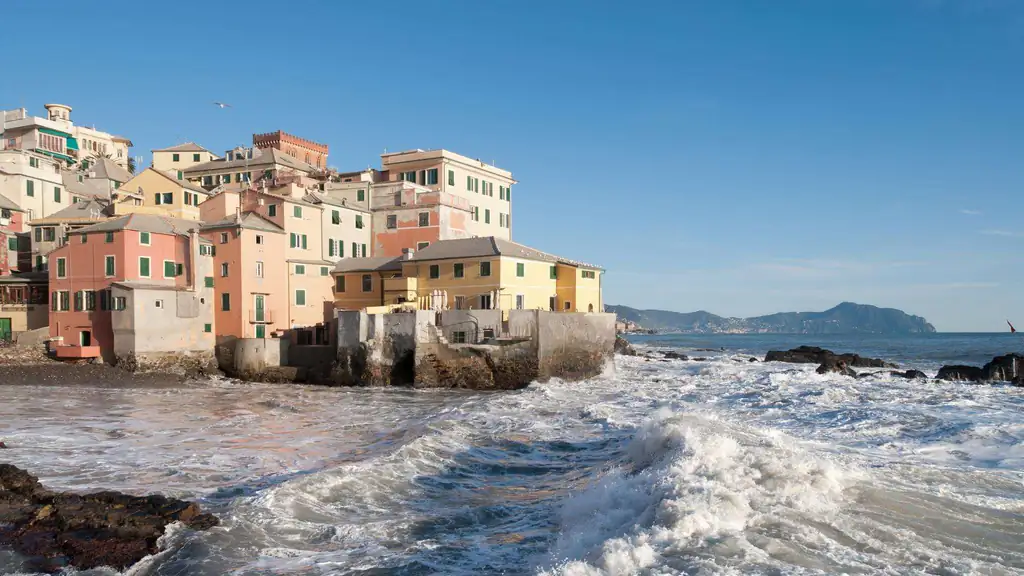
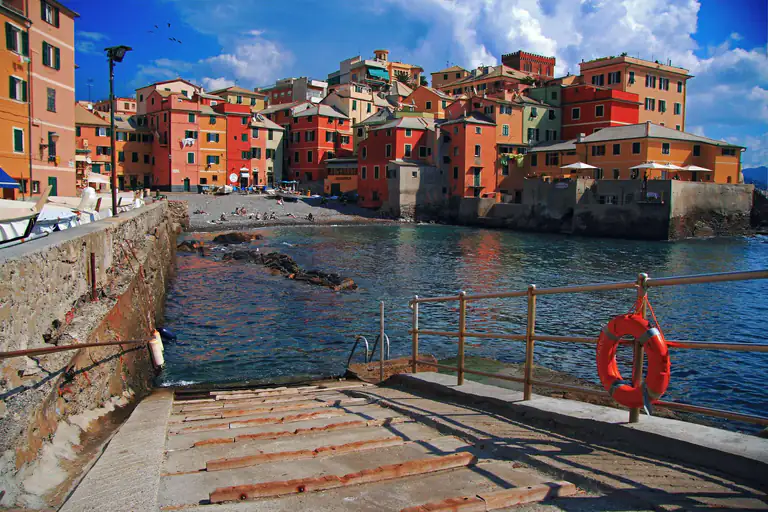
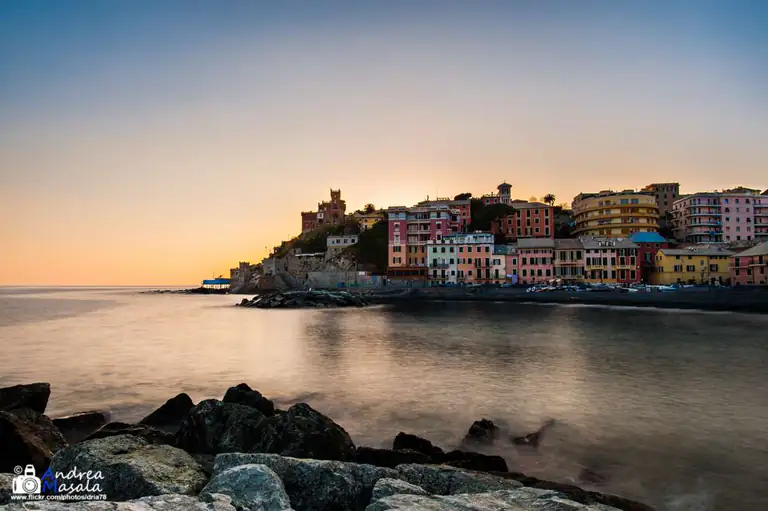
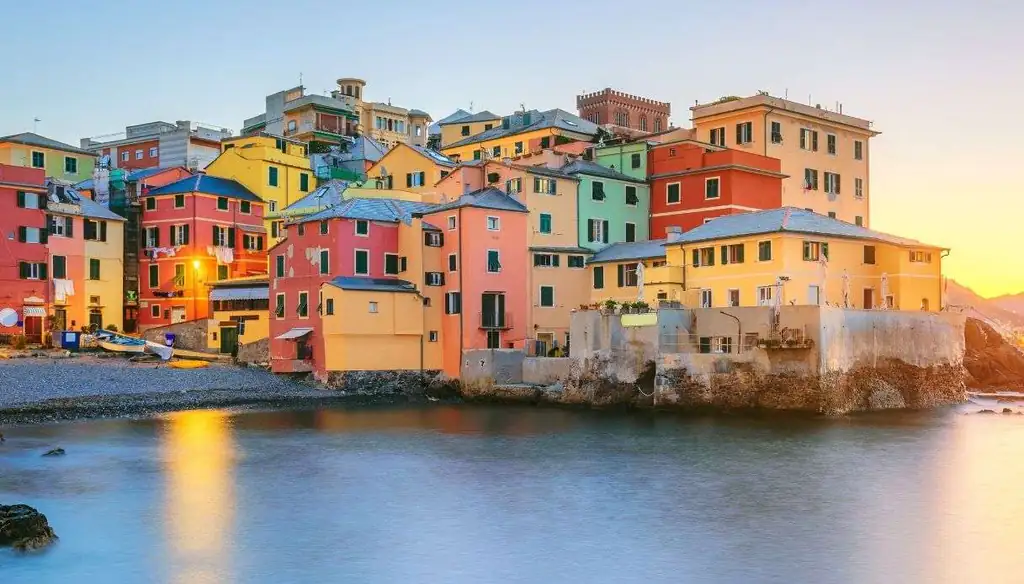
Boccadasse is Genoa’s old fishing village, at the far end of Corso Italia: a small bay with a pebble beach, low colourful houses and a church facing the sea. There is no ticket and no opening time. It is a real, lived-in neighbourhood that you reach on foot or by bus, wander through and have an ice cream in.
By Italian Riviera editorial team·Updated on ·6 min read
The village and its history
Boccadasse has been part of Genoa since 1873. Before that it belonged to the municipality of San Francesco d’Albaro, which a royal decree of 26 October 1873 merged into the city. Three explanations are offered for the name and none is certain: the best known links it to the shape of the bay, like a donkey’s mouth (Genoese bocca d’âze); others point to an old stream called Asse, or to a landowner named Guglielmo Boccadassino.
A popular story says the village was founded around the year 1000 by Spanish fishermen who sheltered in the cove from a storm. It is a legend with no documents behind it, and it should be told as one.
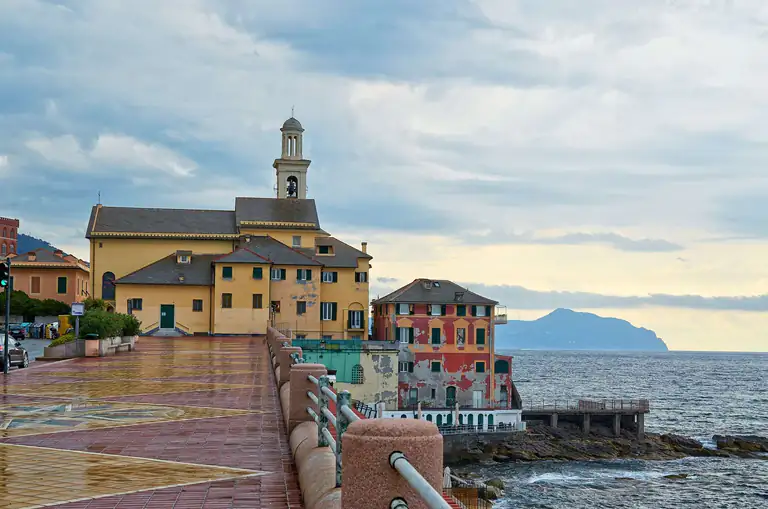
The documented history is more recent. Corso Italia was built between 1909 and 1915 to a design by the engineer Dario Carbone, and it ends right in front of the church of Sant’Antonio. The original plan would have brought the road up against the village houses; local opposition stopped it and the traffic was routed further inland. That is why Boccadasse still has its shape today.
What to see
The beach and Piazza Nettuno
The heart of the village is the small pebble beach, with boats pulled up on the shore and the houses gathered around it. Above the bay is Piazza Nettuno, with bars, restaurants and ice-cream shops. It is the most photographed spot, especially at sunset, and also the busiest.
The church of Sant'Antonio da Padova
The church began as a chapel built by fishermen and local residents and became a parish on 25 March 1894 (sources disagree on the date of the earliest buildings, somewhere between the 1600s and 1700s). The saint’s feast is celebrated on 13 June with an evening procession and a fair on Corso Italia. Corso Italia ends in front of the church.
Capo Santa Chiara and Castello Türcke
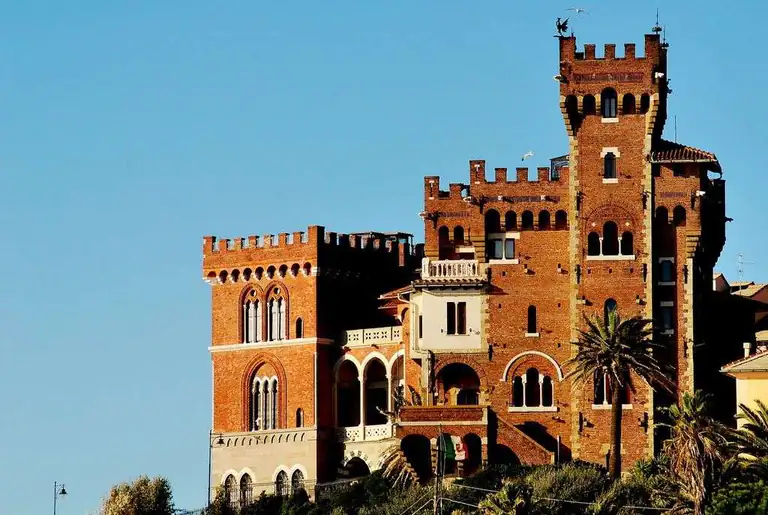
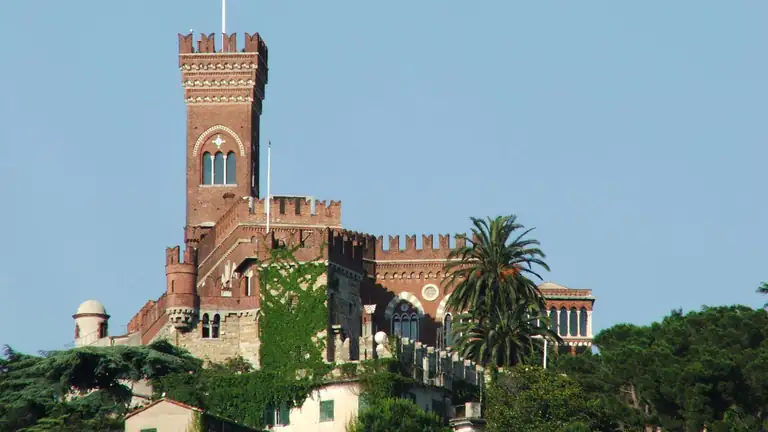
A flight of steps leads from Boccadasse up to Capo Santa Chiara, crowned by Castello Türcke, built in 1903 to a design by Gino Coppedè in Liberty style. You can admire it from the street; we found no official information on visits inside. From the cape you look along the coast to the east.
Vernazzola
Round the other side of the cape, towards Sturla, is Vernazzola, another small fishing village reached on foot along a crêuza, a narrow path between walls. It is less crowded than Boccadasse and worth the detour.
The beach: swimming, rules and access
The beach is free to enter: essentially a pebble sunbathing area with no bathing establishment. The City of Genoa (Municipio VIII) lists it as “always open” and suitable for swimming. In 2026 the lifeguard and water-assistance service ran from 15 June to 13 September, with different hours across the weeks (10:00 to 19:00 from 1 July to 23 August). Outside those dates there is no supervision.
A PVC walkway leads to the water’s edge; the beach is part of the “Genova Sea Inclusion” project
There is an accessible toilet at via Aurora 8 r, and a hot-water shower on site
You cannot reserve a spot: the beach has no facilities
The ground is pebbles: bring water shoes and do not expect sand
Swimming can be banned temporarily after water testing: in September 2025 there was a ban, later lifted. Before you swim, check the signs and the list of ordinances on the City of Genoa website.
What to eat
Boccadasse is also known for its ice cream: bars and gelaterie cluster around Piazza Nettuno and the streets next to the bay. We do not name a particular shop because we found no official source comparing them: choose by the ingredients and the queue. For Ligurian dishes, from focaccia to pansoti, read what to eat in Genoa.
How to get there
The easiest way is a mix of bus and a walk. From Genova Brignole station, about 3.5 km away, bus 31 goes towards Boccadasse; the City of Genoa also lists lines 42 and 607 for the beach. Routes sometimes change for roadworks and events, so check the AMT journey planner before you set out. From Genova Sturla station it is about 1.5 km on foot.
On foot from the city: Corso Italia is a seafront road of more than two kilometres that starts at Foce and ends in front of the church of Sant’Antonio. A cycle lane was added between the road and the pavement in 2022, so watch out for bikes.
By car: the village is a difficult spot. The limited-traffic zone in via Boccadasse is open only to holders of the European disabled badge, who have reserved spaces about 50 metres from the beach entrance. For everyone else we found no official list of nearby car parks: leave the car further away and walk, or use public transport.
Practical tips
Crowds: the village is small and fills up at weekends and on summer evenings; some guides recommend coming early in the morning or after 18:00.
Accessibility: Piazza Nettuno connects to the beach and can be reached from via Boccadasse; the steps up to the cape are steep.
Where to stay: Boccadasse is very small and we see it as a visit rather than a base; for accommodation read where to stay in Genoa.
No, entry is free and the village and beach are always accessible.
How do I get to Boccadasse from Genova Brignole?
By bus 31, which links the station with the area; it is about 3.5 km. Check the up-to-date route on the AMT website.
Can I park in Boccadasse?
Via Boccadasse is a limited-traffic zone, open only to holders of the European disabled badge. We found no official list of car parks for everyone else: public transport or walking is better.
Can I swim in Boccadasse?
Yes, the beach is free and the City lists it as suitable for swimming. In 2026 lifeguards were on duty from 15 June to 13 September. A temporary ban can follow water testing: check the signs.
Is it suitable for people with reduced mobility?
The square and the beach are connected and there is a walkway; the City also reports an accessible toilet and reserved spaces near the entrance. The steps up to Capo Santa Chiara are steep.
Can I walk from Boccadasse to Nervi?
Not in one continuous promenade: Corso Italia ends at Boccadasse. For Nervi, further east, take the train or the bus.
Where to stay
Where to stay in Genoa
All places to stay in Genoa on Booking: compare prices and availability.