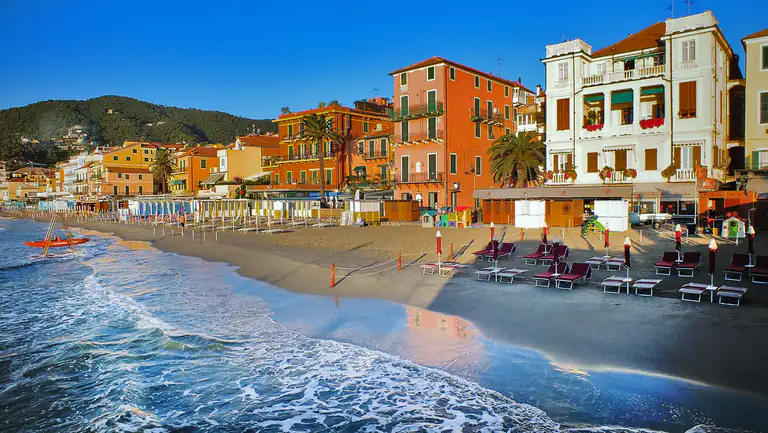

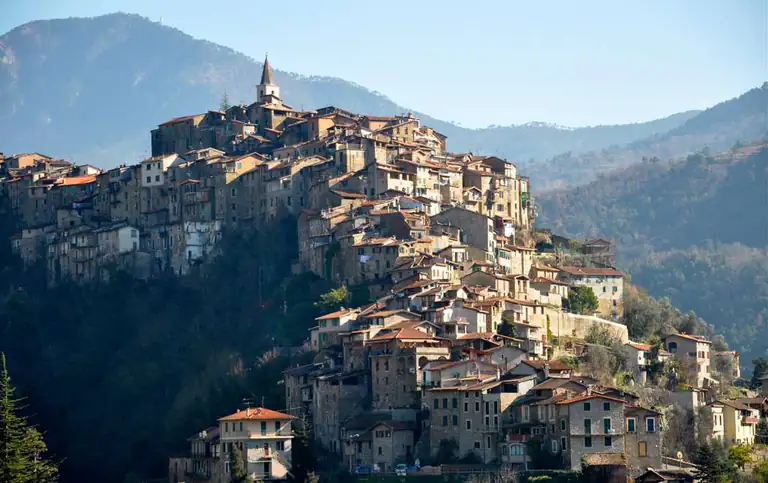
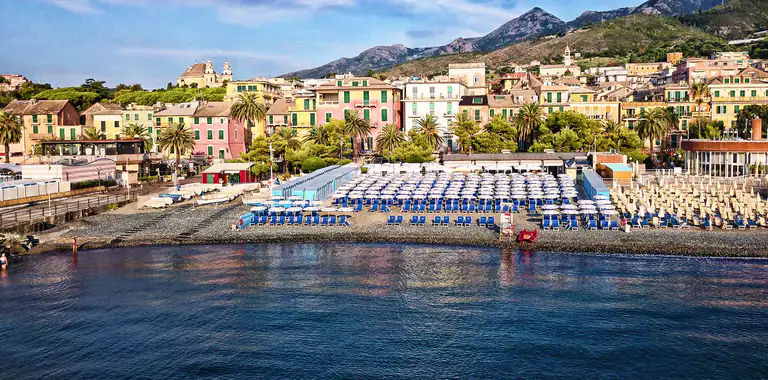
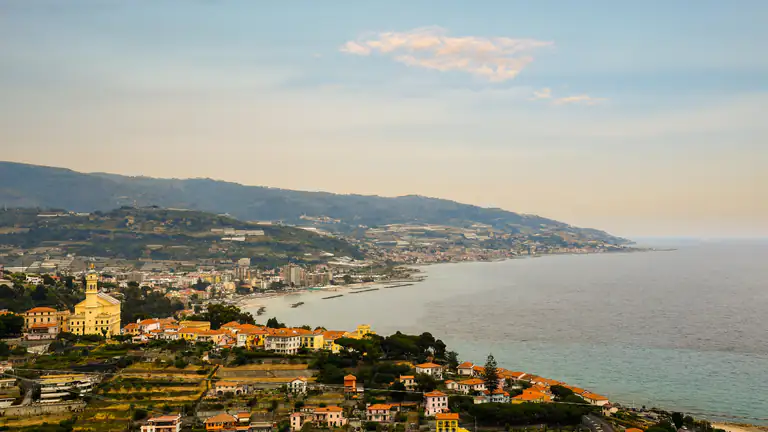
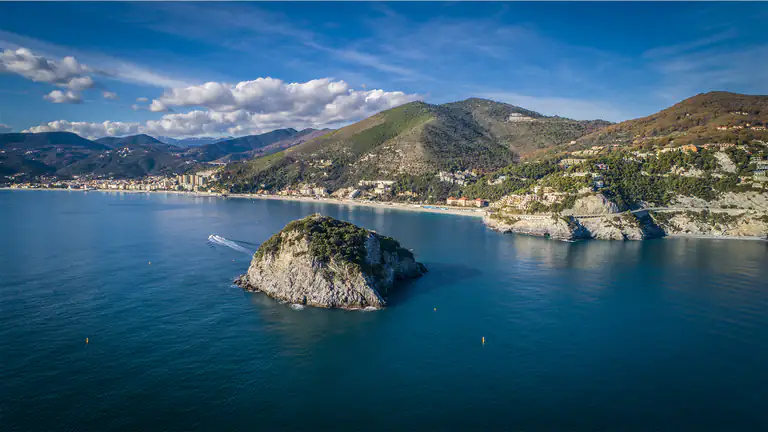
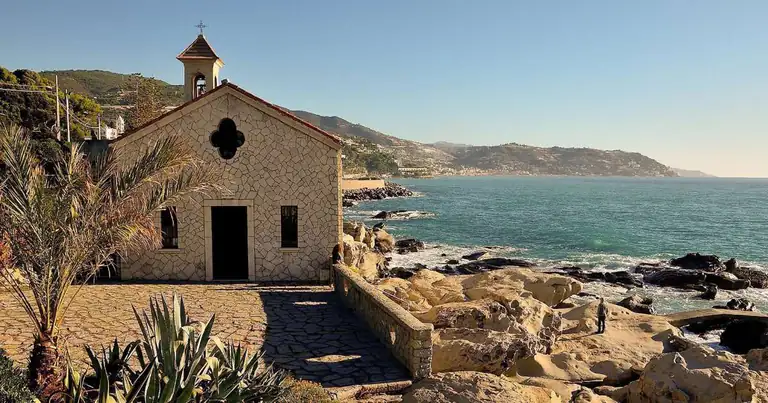
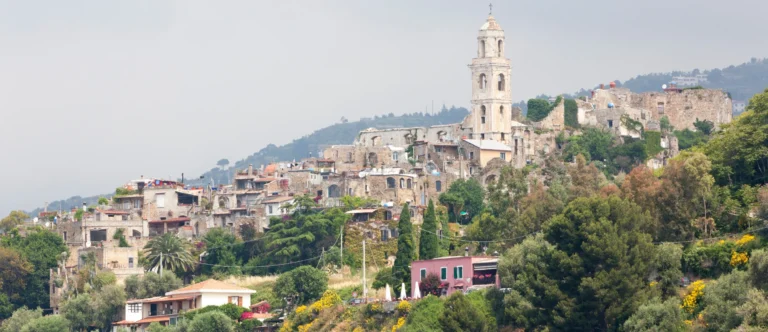
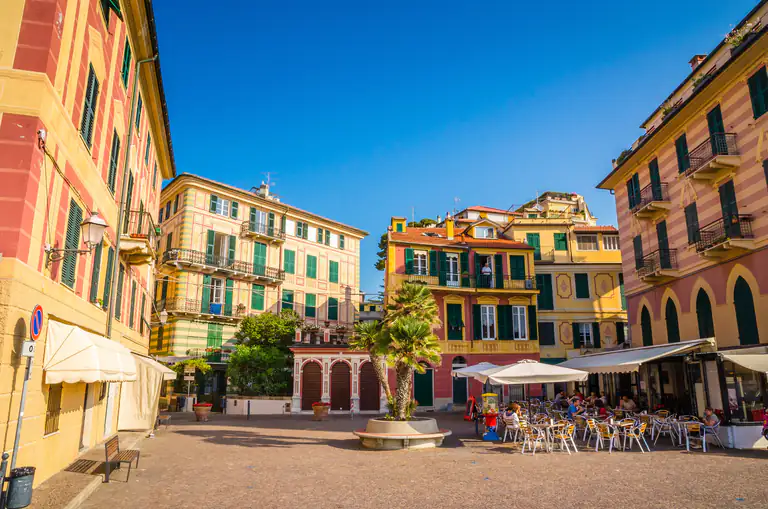
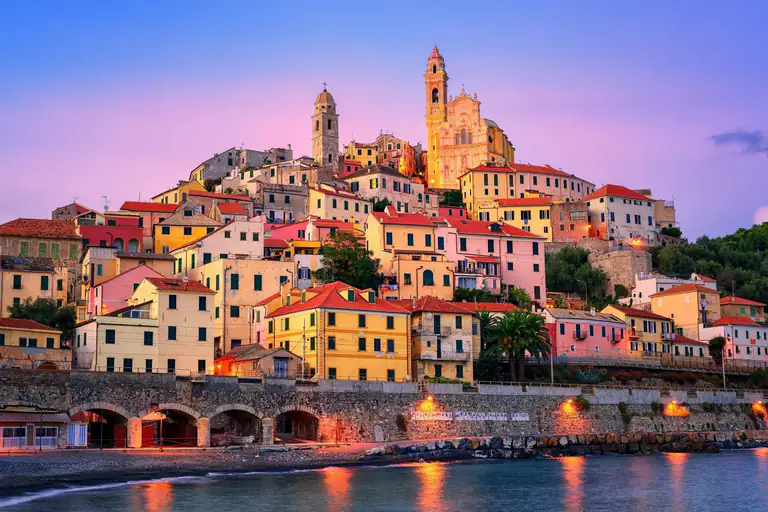
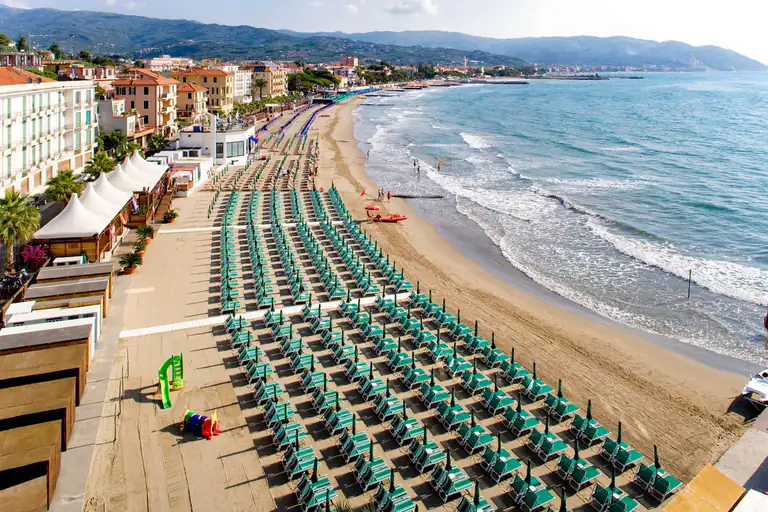
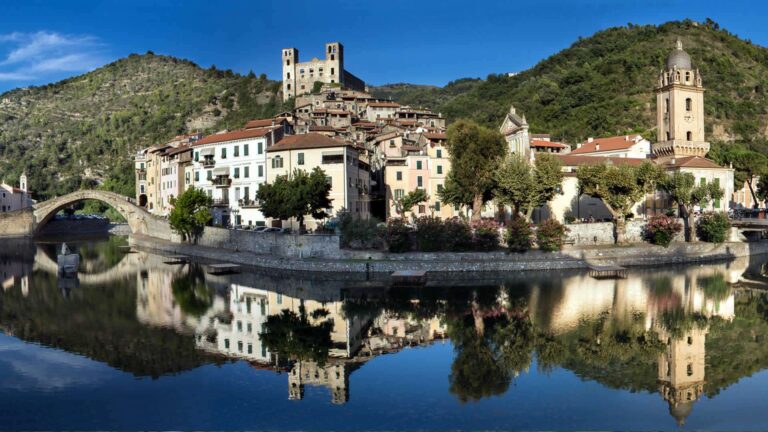
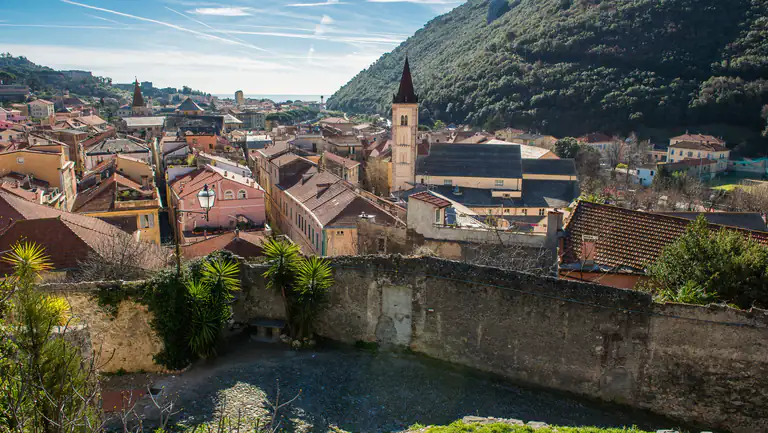
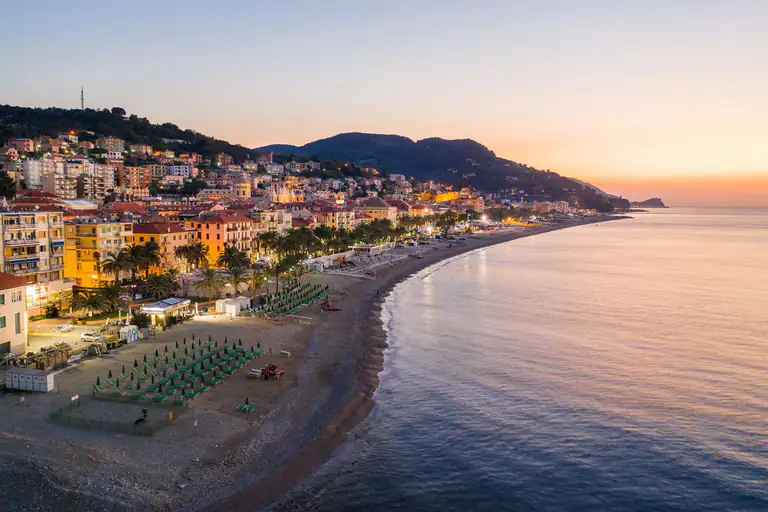

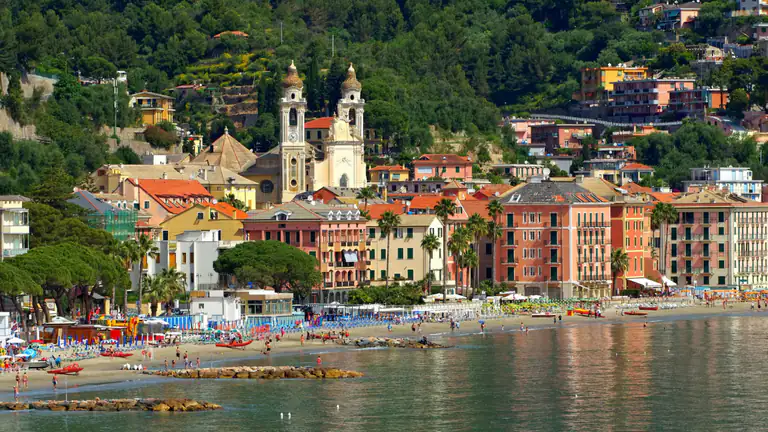
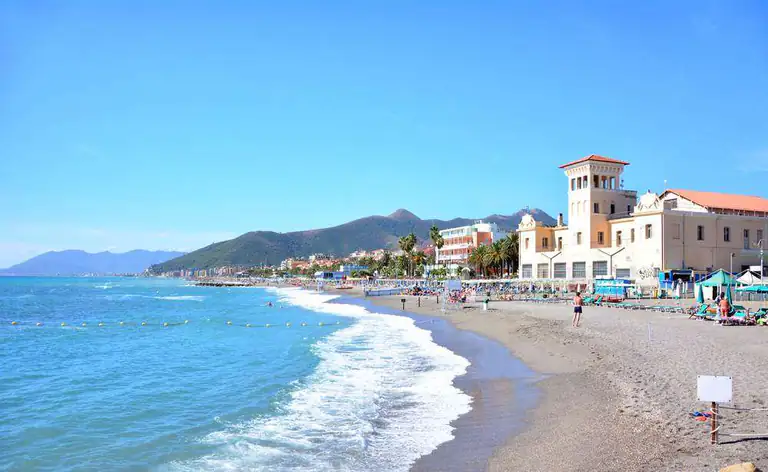
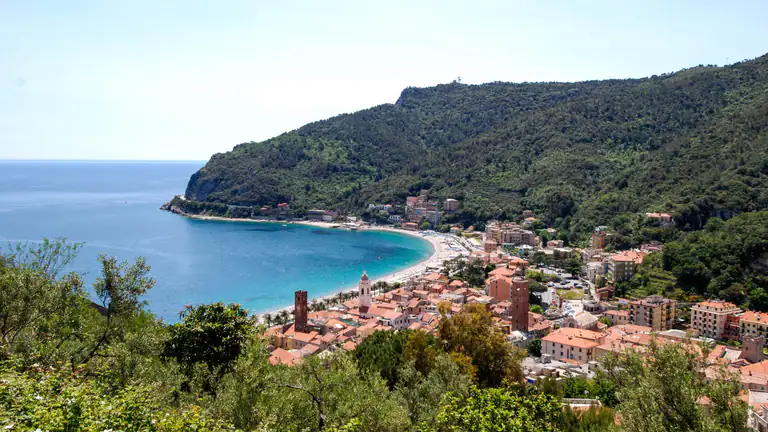
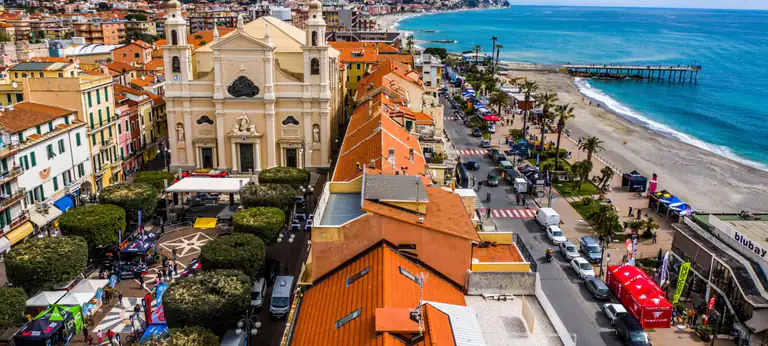
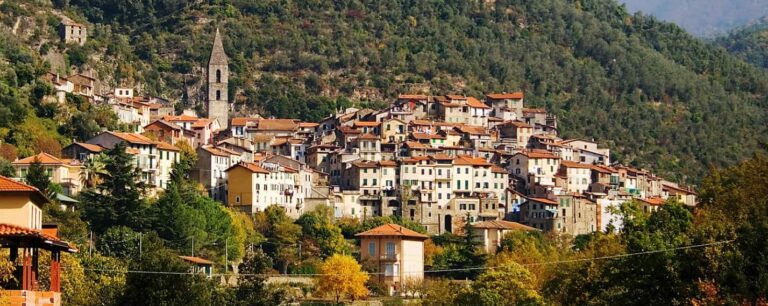
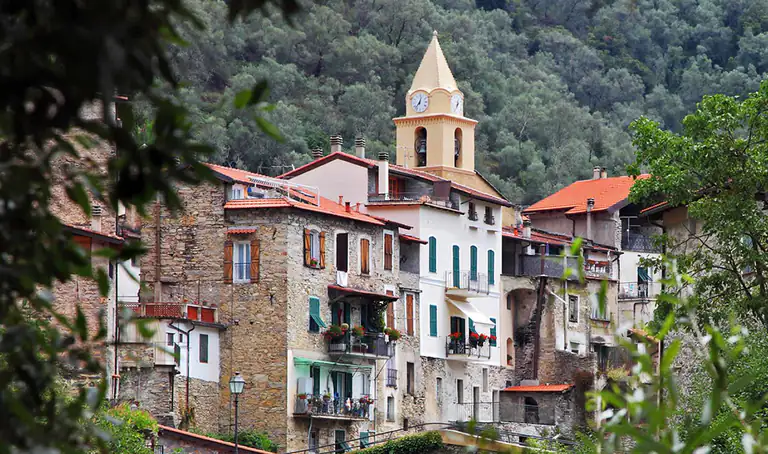
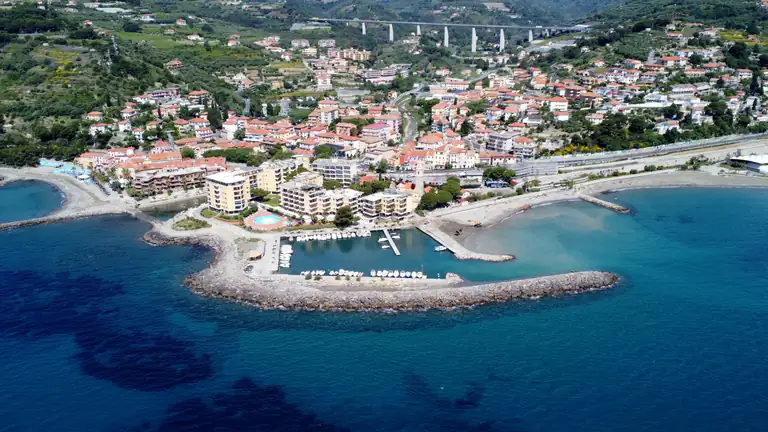
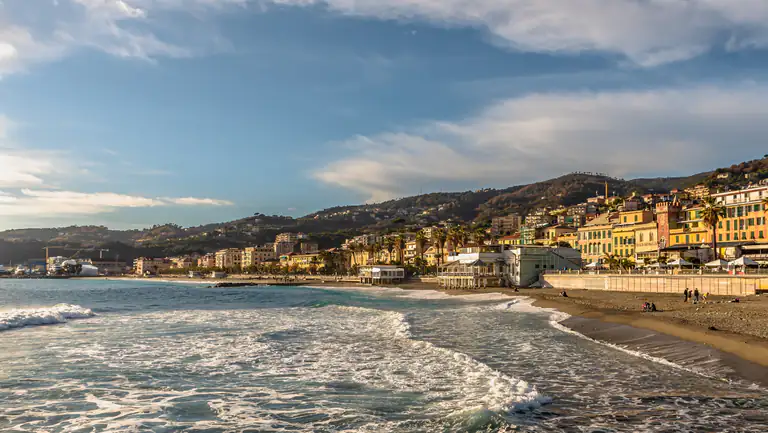
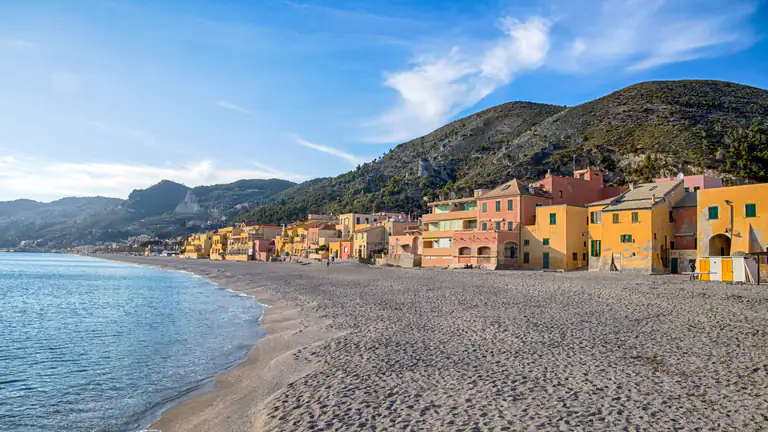
The Riviera di Ponente is the western half of the Ligurian coast: it starts at the French border in Ventimiglia and runs east to the edge of Genoa. It is made of two rivieras with a different character. In the west is the Riviera dei Fiori (Riviera of Flowers), the province of Imperia, with Sanremo, Bordighera and valleys full of medieval villages. In the east is the Riviera delle Palme (Riviera of Palms), the province of Savona, with the long sandy beaches of Alassio, Loano and Finale Ligure. The last stretch before Genoa, with Arenzano, already belongs to the province of Genoa.
Compared with the Riviera di Levante and the Cinque Terre, the coast here is more open, the beaches are wider and often sandy, the winters are among the mildest in Italy, and behind the sea there is a real hinterland of valleys, olive groves and mountains up to 2,200 metres. This guide explains how the area works, what not to miss stretch by stretch, how to get around, where to stay and when to go. The cards for each town are further down the page.
How the Riviera di Ponente is laid out

The coast runs almost straight from west to east, with headlands separating one bay from the next: Capo Mortola at the border, Capo Berta between Imperia and Diano Marina, Capo Mele between Laigueglia and Andora, Capo Noli between Noli and Varigotti. The Genoa–Ventimiglia railway, the old Via Aurelia road and the A10 motorway all follow the coast, so almost every seaside town can be reached without a car.
The two rivieras feel quite different.
- Riviera dei Fiori (province of Imperia): from the French border to Cervo. Nineteenth-century towns built for British and Russian winter visitors, a rockier coast in the west, narrow valleys and stone villages a few kilometres inland. This is the land of flower growing, Taggiasca olive oil and Rossese wine. It has its own detailed guide: Riviera dei Fiori.
- Riviera delle Palme (province of Savona): from Andora to Varazze. The longest sandy beaches in Liguria, family-friendly resorts, medieval villages on the sea such as Noli and, around Finale, one of Europe’s top areas for mountain biking and climbing.
- The Genoa stretch: Cogoleto and Arenzano, where the mountains of the Beigua park come down almost to the beach, half an hour by train from Genoa.
The hinterland is the real surprise. Valleys climb from the coast and in half an hour’s drive you reach villages of a few hundred people: the Val Nervia and Valle Argentina behind Imperia’s coast, the plain of Albenga, the hills around Finale, the Beigua mountains behind Varazze.
What not to miss, area by area
Each stretch of the Riviera di Ponente has its own speciality. Here are the highlights, from west to east.
Ventimiglia, Bordighera and the Val Nervia
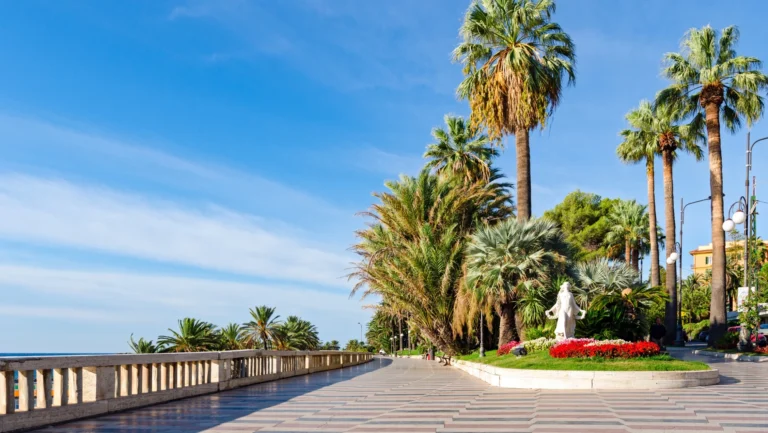
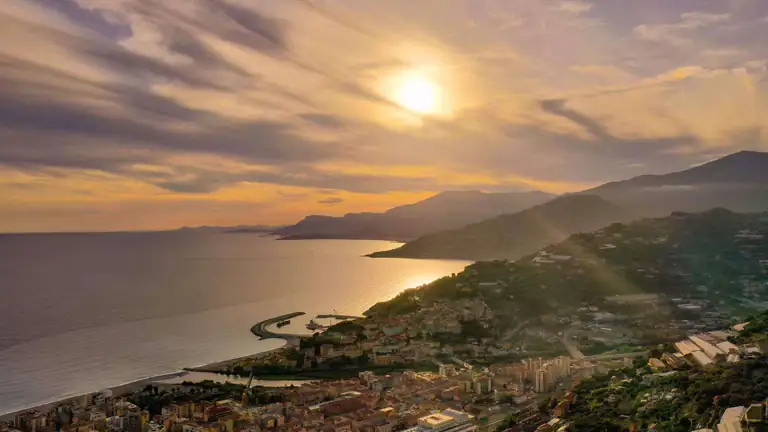
Ventimiglia is Italy’s front door: a medieval old town on the hill, the big Friday market, the Hanbury Botanical Gardens at La Mortola and the prehistoric caves of the Balzi Rossi right on the border. Five kilometres away is Bordighera, the town of palm trees, with its old village on the Capo, the seafront promenade and the villas of the British colony. Claude Monet painted here for almost three months in 1884, a story told in Monet in Bordighera.
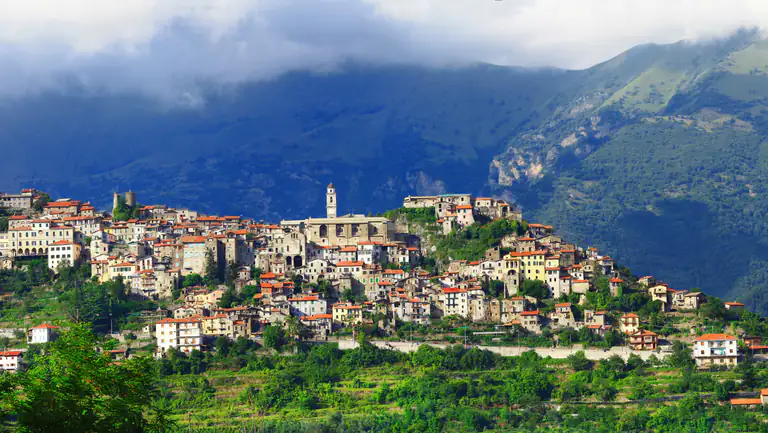
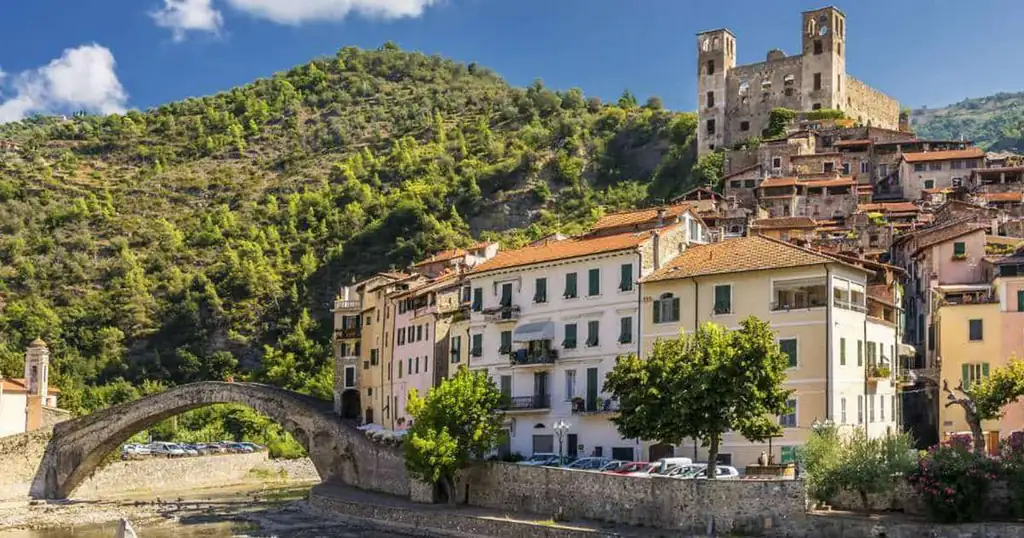
Inland lies the Val Nervia, with Dolceacqua and its medieval bridge, Apricale, Pigna and the river pools of Rocchetta Nervina. Above Bordighera sits Seborga, the village of the self-declared “Principality”.
Sanremo, Taggia and the Valle Argentina
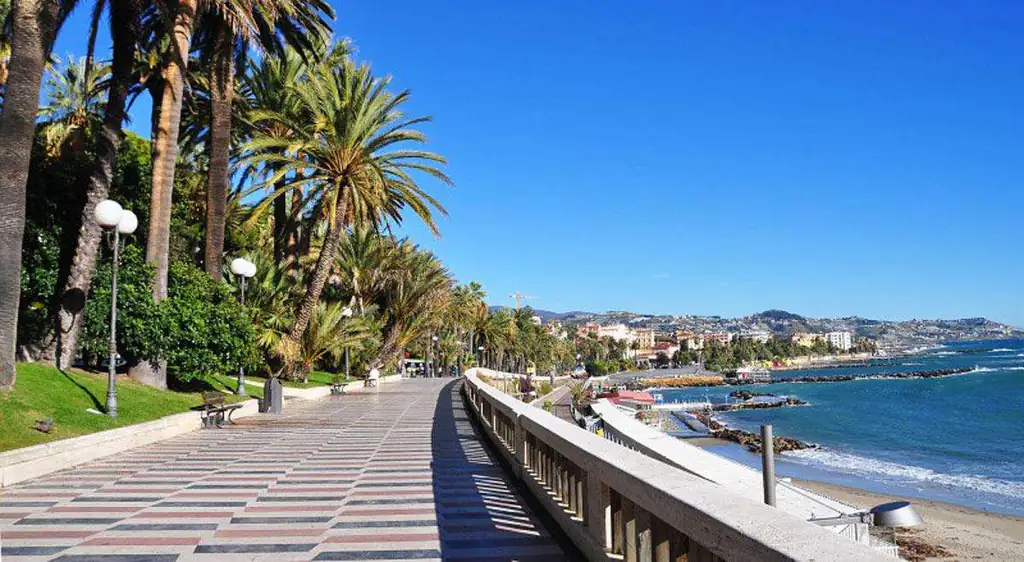
Sanremo is the largest and liveliest town on the riviera: the medieval quarter called La Pigna, the Art Nouveau Casino, the palm-lined Corso Imperatrice and the Italian Song Festival in February. Just east are the artists’ village of Bussana Vecchia and the sandy beach of Arma di Taggia. Follow the Valle Argentina inland to Triora, the “witches’ village”, at 780 metres.
Imperia and the Gulf of Diano
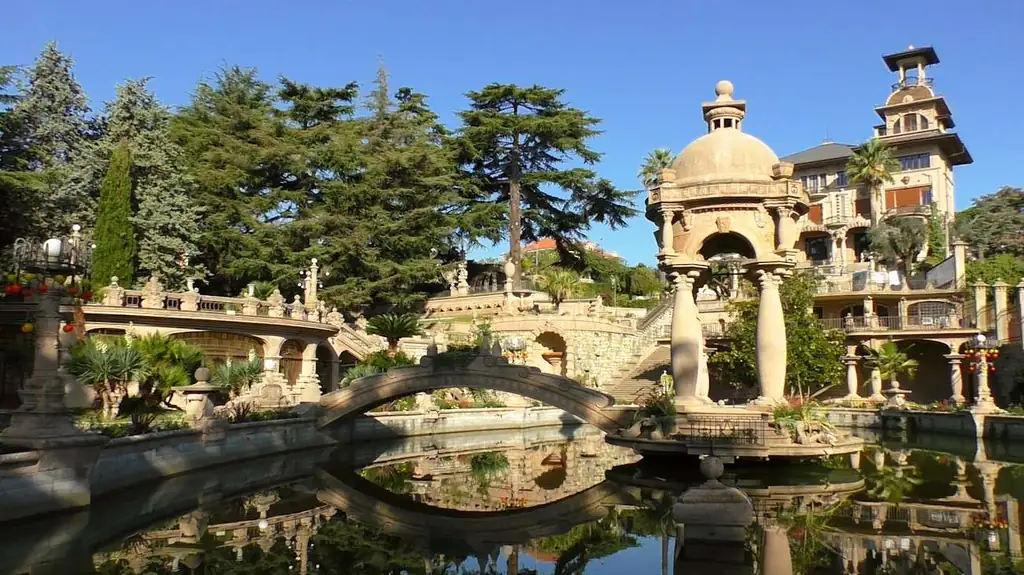
Imperia is two towns in one: Porto Maurizio, with the Parasio quarter on its headland, and Oneglia, with its fishing harbour and olive oil tradition. Between them is Villa Grock and its clown museum. To the west, San Lorenzo al Mare is the smallest municipality in Liguria; to the east, the Gulf of Diano combines the sandy beach of Diano Marina with the Baroque village of Cervo. For the valleys and the cycle path along this stretch, see the Riviera dei Fiori guide.
Alassio, Albenga and the Baia del Sole
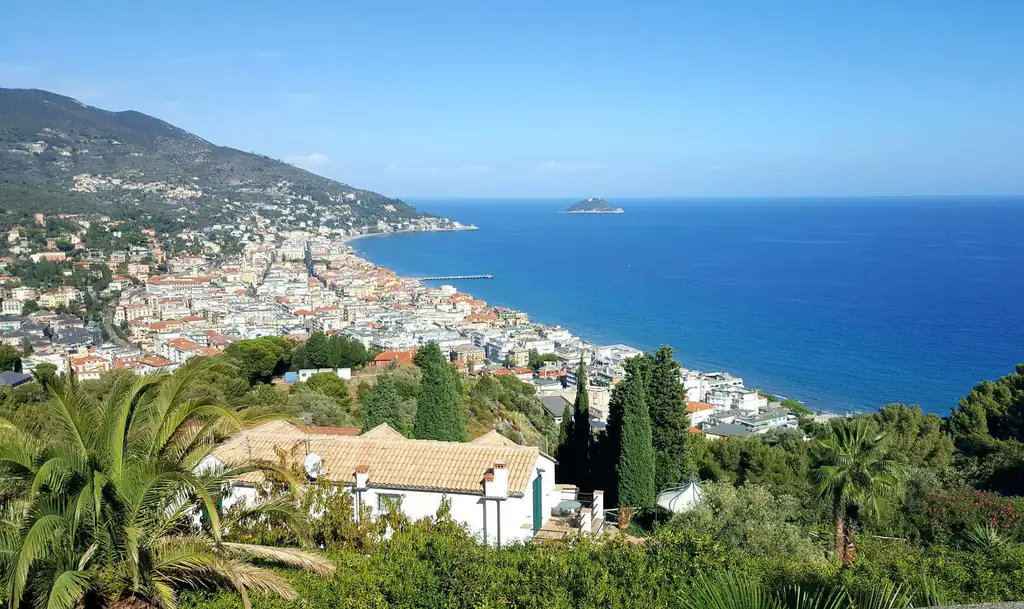
Past Capo Mele the Riviera delle Palme begins. Laigueglia is a fishing village with houses right on the sand and a footpath up to Colla Micheri. Alassio has more than three kilometres of fine sand, the Muretto wall signed by celebrities and Gallinara island offshore; every stretch of coast is covered in Alassio’s beaches. Albenga is the town of medieval towers, at the centre of a farming plain known for purple asparagus and spiny artichokes, covered in Albenga’s local produce.
Loano, Pietra Ligure and the Finale area

Loano and Pietra Ligure are family seaside towns with gently shelving beaches, long promenades and a Blue Flag in 2026; from Loano the Toirano Caves are a short drive away. Finale Ligure is made of three villages: Finalmarina on the sea, Finalpia and Finalborgo, enclosed by fifteenth-century walls. Behind them are more than 200 mountain bike trails and over 4,000 climbing routes. To the east, the hamlet of Varigotti has pastel houses built straight onto the beach.
Noli, Bergeggi and Savona
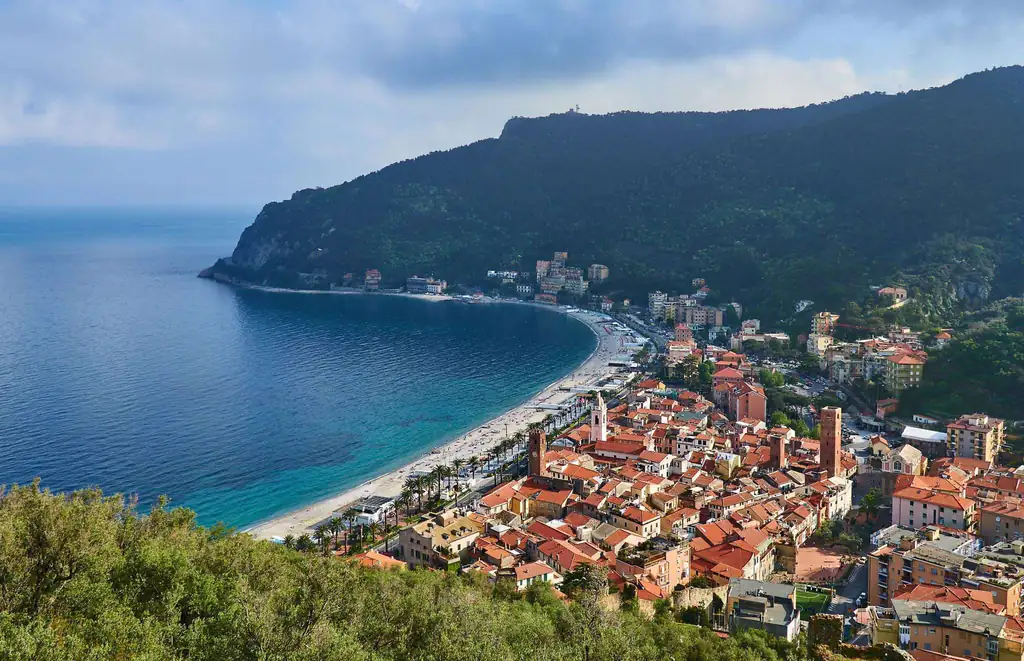
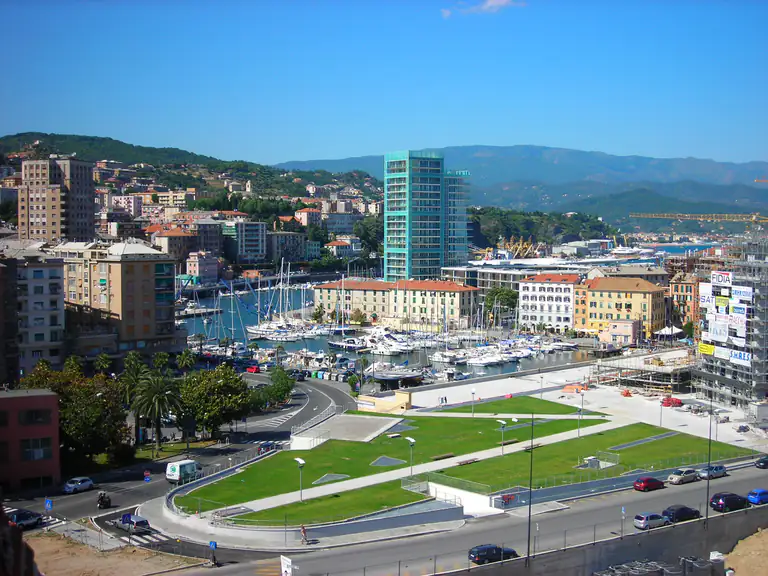
Noli was a small independent maritime republic from 1192 to 1797: towers, walls climbing to the castle and a bay where fishermen still pull their boats onto the beach. You can walk there from Varigotti on the Pilgrim’s Path. Bergeggi is the place for snorkelling, with an island and a sea cave inside a Marine Protected Area (Bergeggi island). Savona is a real working city, with the cruise terminal, the Priamar fortress and the “Sistine Chapel” of the Della Rovere popes; if you arrive by ship, see Savona on a cruise stop.
Celle Ligure, Varazze and Arenzano
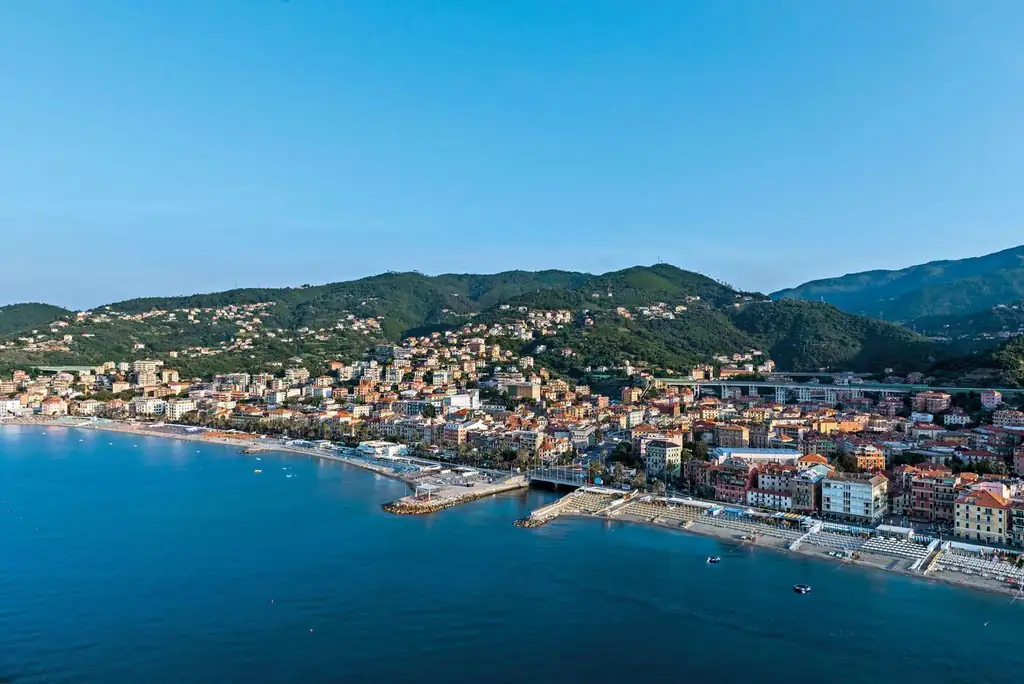
The last stretch before Genoa is the closest to the city and the easiest by train. Celle Ligure is a fishing village with colourful houses on the beach. Varazze has an old town inside medieval walls, a long beach, a marina, and is one of Italy’s best-known surf spots; the Passeggiata Europa links it to Celle on foot and by bike. Arenzano, runner-up in Italy’s “Borgo dei Borghi” contest in 2026, has a large park with peacocks and Beigua trails starting from town.
Hotels, B&Bs and apartments all over Liguria: compare prices and availability.
Beaches of the Ponente
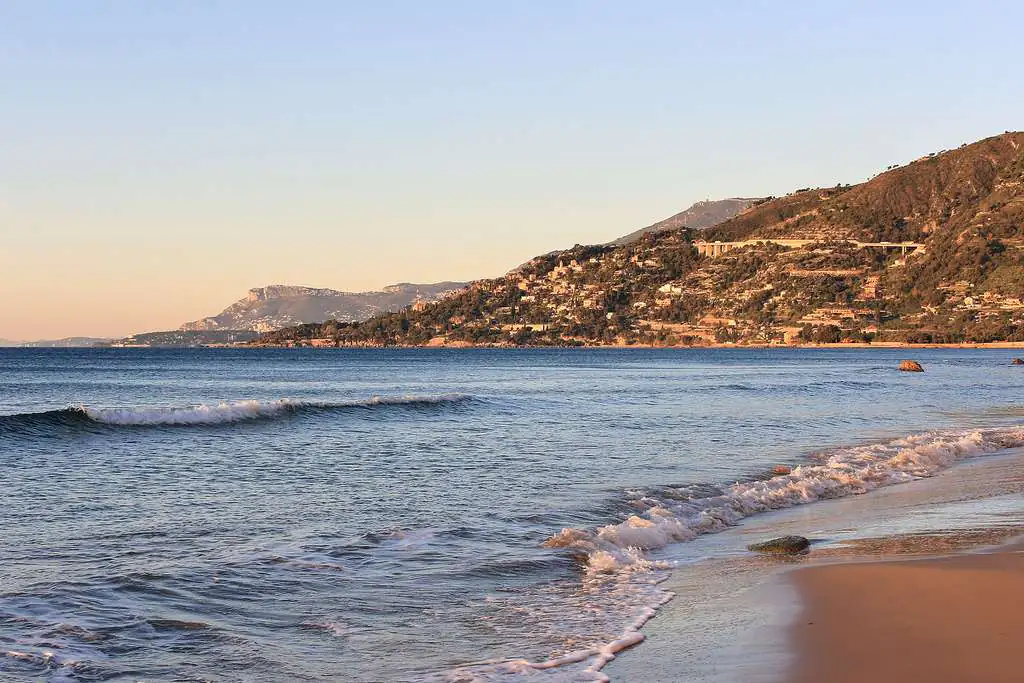
As a rule, the further east you go, the longer and sandier the beaches. The province of Savona has the longest stretches of sand in Liguria: Loano, Pietra Ligure, Finale Ligure and Alassio. They are well-equipped beaches with shallow water, ideal with children. For a full selection across the region see sandy beaches in Liguria.
On the Riviera dei Fiori the coast alternates pebbles, rocks and a few sandy beaches, such as Arma di Taggia, Diano Marina and Le Calandre in Ventimiglia (Ventimiglia’s beaches). For Bordighera and Sanremo there are dedicated guides: Bordighera’s beaches and Sanremo’s beaches. Towards Genoa pebbles and coarse sand return: see Celle Ligure, Varazze and Arenzano. The complete overview is on beaches in Liguria.
Outdoors: bikes, trails and sea
The Ponente is the part of Liguria best suited to active travellers. Three experiences are worth the trip on their own:
- The Riviera dei Fiori cycle path: built on the old railway line, since June 2026 it runs continuously for almost 48 km between Ospedaletti and Andora, nearly flat and right by the sea. All the details in the Riviera dei Fiori cycle path.
- The Finale area: mountain bike and enduro trails, limestone crags, and the castles above Finalborgo (Finalborgo’s castles). From 16 to 18 October 2026 it hosts the UCI Enduro World Championships.
- The mountains behind: the Beigua park behind Varazze and Arenzano, the Ligurian Alps nature park above Pigna and Triora, and the pools and canyon of Rocchetta Nervina (Rocchetta Nervina’s river pools).
In summer, snorkellers will find the best-protected water on the coast at Bergeggi.
What to eat in western Liguria
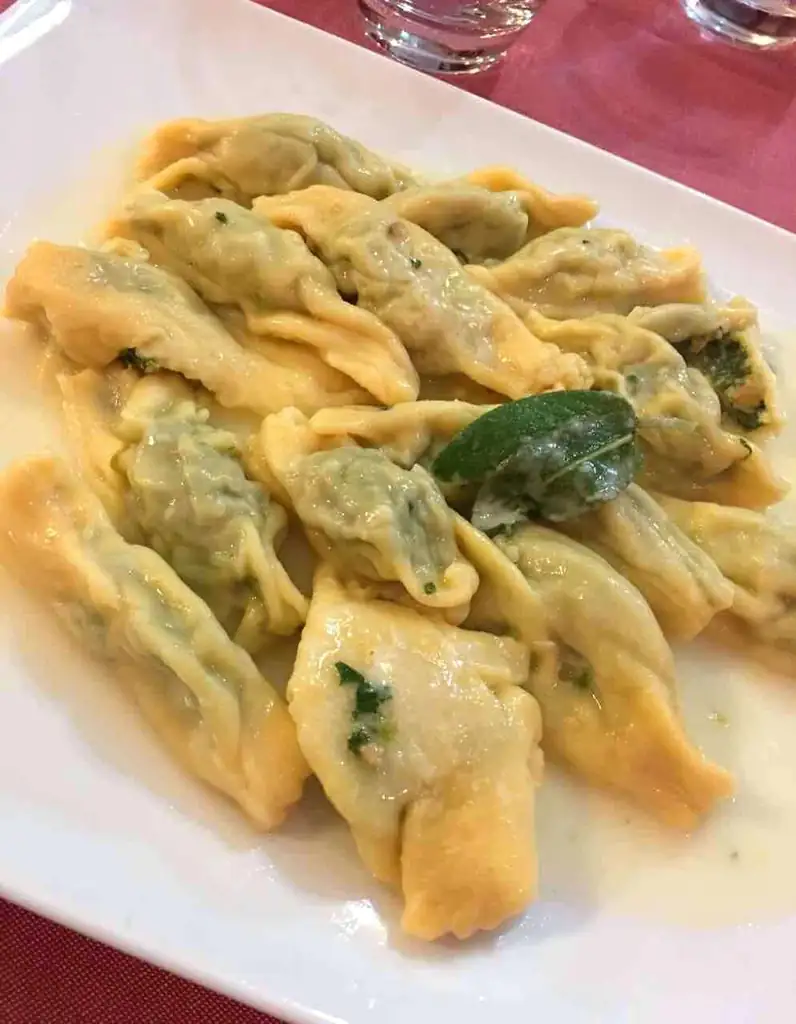
Food in the Ponente is built on olive oil, vegetables and herbs more than fish. The signature product is the Taggiasca olive, named after Taggia, which goes into everything: rabbit Ligurian-style, Sanremo’s sardenaira flatbread, vegetable pies. From the hinterland come herb-filled ravioli, the white beans of Pigna (a Slow Food Presidium) and Rossese di Dolceacqua, the area’s best-known red wine.
On the Riviera delle Palme the products change: purple asparagus and spiny artichokes from Albenga, white farinata and chinotto from Savona. For pesto, focaccia and Genoese cooking, see what to eat in Genoa.
Getting around the Riviera di Ponente
By train
The Genoa–Ventimiglia line serves almost every seaside town. It is slow but practical: stations are nearly always in the centre. Approximate times from Genoa on the fastest trains:
| From Genoa to | Train time |
|---|---|
| Arenzano | 35–40 minutes |
| Savona | about 1 hour |
| Finale Ligure | about 1 hour |
| Loano | 1 hour – 1 hour 15 |
| Alassio | 1 hour 40 – 2 hours |
| Sanremo | about 2 hours |
| Bordighera | about 2 hours (Intercity) |
Be aware that between Finale Ligure and Andora the line is still single-track for about 32 km: trains are less frequent and delays spread easily. There are direct Intercity trains from Milano Centrale to Sanremo (about 3.5–4 hours). From Ventimiglia, French regional trains reach Nice in about an hour. Timetables change with the season, so always check on the Trenitalia website.
By car
The A10 Genoa–Ventimiglia motorway runs parallel to the coast, mostly through tunnels and on viaducts, and continues across the border as the French A8 to Nice. The Aurelia road goes through the towns instead: scenic, but slow in summer. You mainly need a car for the hinterland, where buses are few; in old towns and on the seafront in summer, parking is the main headache (see parking in Sanremo and parking in Bordighera).
By plane
There are two airports with scheduled flights. Nice Côte d’Azur is the most convenient for the Riviera dei Fiori: about 50 minutes’ drive from Ventimiglia, just over an hour from Sanremo. Genoa Cristoforo Colombo works better for the Riviera delle Palme: about 20 km from Arenzano, around 40 from Savona and about an hour’s drive from Alassio. Villanova d’Albenga airport has no scheduled flights.
Where to stay on the Riviera di Ponente
The right base depends on what you want to do. Practical tip: pick a town with a station in the centre, so you can do coastal day trips without a car.
- To explore the Riviera dei Fiori and the Côte d’Azur: Bordighera or Sanremo. Bordighera is half an hour from Menton and close to the valleys; see where to stay in Bordighera.
- For a beach holiday with children: Diano Marina, Alassio, Loano, Pietra Ligure. Sand, shallow water, everything on foot.
- For biking, climbing and hiking: Finale Ligure or Finalborgo.
- To travel a lot by train or arrive from Genoa: Savona, Varazze, Arenzano.
- For peace and quiet: a farm stay or a house in an inland village such as Apricale or Dolceacqua, as long as you have a car.
For a comparison of areas across the whole region, see where to stay in Liguria.
From Bordighera you can reach Menton, Monaco, Dolceacqua and Sanremo as day trips: travel times and transport are in Bordighera as a base for day trips.
When to go
The Ponente has a very mild Mediterranean climate. In Sanremo the January average is about 11°C and August about 24–25°C; snow on the coast is extremely rare. The sea reaches about 21°C in June, 24–25°C in August and stays above 20°C until October.
- June and September: the best time for the beach, with warm water and fewer crowds.
- July and August: high season, high prices and hard parking; book early.
- Spring and autumn: ideal for villages, trails and cycling. February brings the Sanremo Festival (16–20 February in 2027), spring the flower parade.
- Winter: many towns on the Riviera dei Fiori stay lively all year; this is the season they were built for in the 1800s. Some hotels and beach clubs in smaller places close.
For forecasts and month-by-month climate see weather in Liguria.
Frequently asked questions
Where does the Riviera di Ponente start and end?
It runs from the French border at Ventimiglia to the edge of Genoa. It includes the Riviera dei Fiori (province of Imperia), the Riviera delle Palme (province of Savona) and the first stretch of the province of Genoa, with Cogoleto and Arenzano.
What is the difference between the Riviera dei Fiori and the Riviera delle Palme?
The Riviera dei Fiori is the Imperia stretch, from Ventimiglia to Cervo: 19th-century winter resorts like Sanremo and Bordighera, a rockier coast and valleys with medieval villages. The Riviera delle Palme is the Savona stretch, from Andora to Varazze: longer sandy beaches and family resorts.
Which is the best town on the Riviera di Ponente?
It depends on what you want. For an elegant town that is lively all year, Sanremo or Bordighera. For the beach with children, Alassio or Loano. For a medieval village on the sea, Noli or Cervo. For the hinterland, Dolceacqua and Apricale.
Can you visit the Riviera di Ponente without a car?
Yes, for the coast. The Genoa–Ventimiglia train stops in almost every seaside town and stations are central. You need a car for inland villages, where buses are few and often run only on weekdays.
Which is the nearest airport?
For the Imperia side it is Nice, about 50 minutes’ drive from Ventimiglia. For the Savona side and Arenzano it is Genoa, about 20 km from Arenzano and around 40 km from Savona.
Where are the sandy beaches in western Liguria?
The longest are in the province of Savona: Alassio, Laigueglia, Loano, Pietra Ligure, Finale Ligure. On the Riviera dei Fiori there is sand at Arma di Taggia, Diano Marina, San Lorenzo al Mare and Le Calandre in Ventimiglia.
How many days do you need?
A week lets you see one of the two rivieras properly, mixing beach and villages. For both, allow at least ten days, ideally changing base halfway: one in the Imperia area and one in the Savona area.