Ligurian canestrelli are buttery shortbread biscuits shaped like a small flower with six rounded points and a hole in the middle, dusted with icing sugar. The best-known version is the canestrelletto di Torriglia, from the upper Val Trebbia inland from Genoa. They are sweet and crumbly and need only a few ingredients: flour, butter, sugar, one egg and a little lemon.
The name causes confusion: «canestrelli» is also used for Piedmontese wafers and for savoury rings. Here is the Ligurian recipe, with the amounts most sources agree on, the mistakes that make them tough, and where to try them.
- Origin: Torriglia, upper Val Trebbia (Genoa hinterland); recognised traditional agri-food product (PAT)
- Total time: about 1 hour 10 minutes, including 30 minutes chilling
- Yield: about 25 biscuits
- Difficulty: easy
- Key ingredients: flour, butter, sugar, one egg, lemon zest, icing sugar
- When: all year; once a festive treat
Ingredients

Makes about 25 biscuits.
- 300 g plain flour (Italian type 0)
- 250 g soft butter
- 100 g caster sugar
- 1 egg (the yolk in the dough, the white for brushing)
- grated zest of an unwaxed lemon, to taste
- icing sugar, to finish
How to make it
- Take the butter out of the fridge about 20 minutes ahead: it should be soft, not melted.
- Separate the egg and keep the white aside. Pile the flour on the work surface and put the sugar, diced butter, yolk and lemon zest in the middle.
- Mix quickly, only until the dough holds together. Wrap it in cling film and chill for at least 30 minutes.
- Heat the oven to 180 °C (conventional, not fan) and line a baking tray with baking paper.
- Roll the dough out to about 1 cm thick on a floured surface.
- Cut the biscuits with a six-point flower cutter of 5–6 cm and make the hole in the middle, about 1.5 cm. Re-roll the offcuts as little as possible.
- Place the biscuits on the tray, well spaced, and brush them with lightly beaten egg white.
- Bake for about 15–20 minutes: they should stay pale, only lightly golden at the edges.
- Let them cool on a rack, because they are very fragile when just baked. When cold, dust them generously with icing sugar.
Tips and common mistakes
- Soft butter, not warm. If the dough gets warm it turns sticky and the biscuits lose their crumble: put it back in the fridge for a few minutes.
- Work it as little as possible. Overworked dough gives hard biscuits. Re-roll the offcuts only once.
- Do not let them brown. Torriglia canestrelli are pale. Sources give different temperatures, from 140–150 °C with a longer bake up to 180 °C: adjust to your oven and the thickness.
- Sharp points. To keep the shape, some people put the tray in the freezer while the oven heats up.
- Afterwards. They stay crumbly for 3–4 days in an airtight tin.
- Allergens. They contain gluten, eggs and milk.
Variations
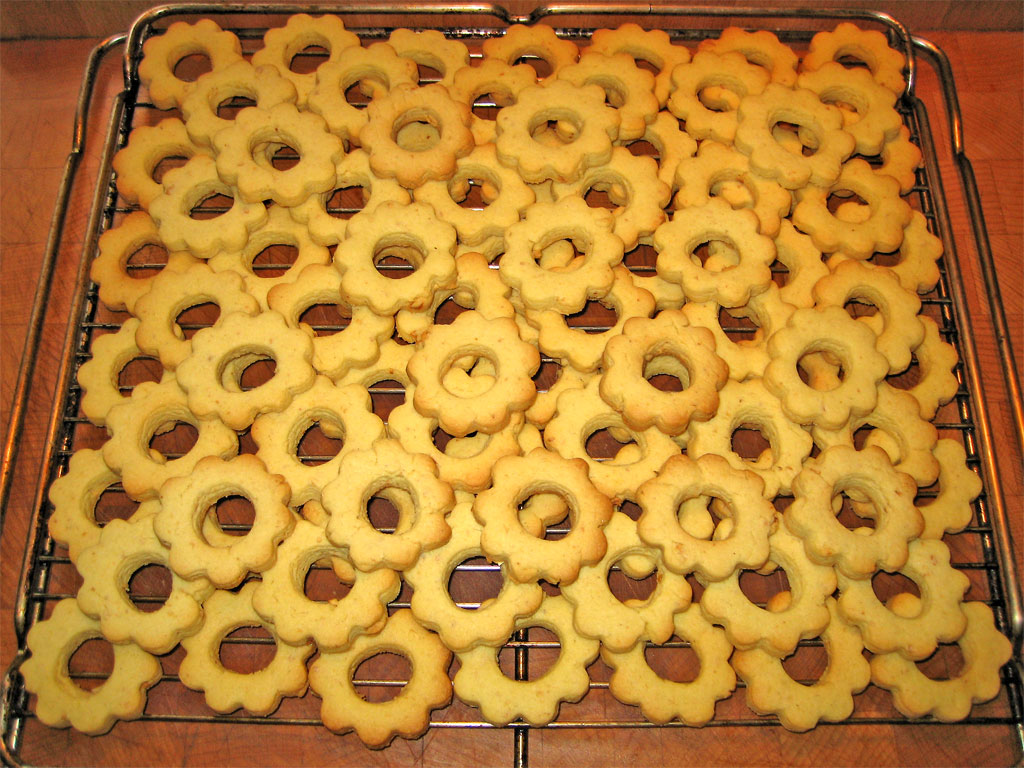
- Torriglia recipe and home recipes. Amounts vary from family to family: some use two yolks, others one, some add liqueur (often rum) or a little milk. A sheet from the Antola Regional Park gives another proportion (500 g flour, 300 g butter, 150 g sugar, 2 eggs, ammonium bicarbonate, milk) and a larger biscuit, about 10 cm with a 3 cm hole.
- With hard-boiled yolks. Many widely shared blog recipes use hard-boiled yolks, potato starch and icing sugar. The result is a sandier dough, different from the Torriglia one.
- Flavours. Lemon or vanilla are the most common. Hazelnut, cocoa, chestnut flour or chocolate-coated versions are more recent variations that the pastry shops of Torriglia sell.
- Canestrellini. The small, one-bite version: La Sassellese in Sassello says it invented it.
- Other canestrelli. In Taggia they are savoury rings made with olive oil, a different thing. Those of Santo Stefano d’Aveto are another local version recognised as PAT. In Piedmont «canestrelli» are often wafers.
History and origin

The canestrello has a long history, with several uncertain points. The earliest written trace quoted by sources dates from 1576: a muleteer robbed on the Val Trebbia road, with a «basket of canestrelli» among the goods. In the nineteenth century Maria Avanzino, known as Donna Pollicina, wife of the owner of Torriglia’s first café, began selling them to customers; sources disagree on the year, between the start and the end of the century.
One tradition says a stylised canestrello appears on thirteenth-century Genoese coins as a symbol of abundance: we could not find it in verifiable sources, so take it as a story. The origin of the name is not certain: from «canestro» (the basket where they cooled) or from the mould. The number of points has changed over time: eleven, then nine, now six.
The biscuit even entered popular speech. On the tomb of Caterina Campodonico, a street seller of the early 1800s, the epitaph begins «A son de vende reste e canestrelli»: her statue stands in the Staglieno Monumental Cemetery in Genoa and holds a string of hazelnuts.
Today the canestrelletto di Torriglia is on the national list of traditional agri-food products. The name is a registered trademark and an association of producers monitors the production rules.
Where to try it in Liguria
The place to go is Torriglia, in the Genoa hinterland, in the upper Val Trebbia and the Antola Regional Park. The town’s pastry shops and bakeries still make them, and there is a festival dedicated to the canestrelletto every year (sources place it between May and June: ask the town hall for the date before you go). Torriglia does not have a page on our site yet.
From the Riviera you can combine the trip with other stops: in Sassello, inland from Savona, La Sassellese makes canestrelli and canestrellini (Sassello’s amaretti are the town’s other sweet). In Santo Stefano d’Aveto canestrelli appear among the local specialities. For the rest of the Ligurian table see our guide to Ligurian food, the torta pasqualina and the Genoese focaccia.
What to drink
They traditionally go with tea or a sweet wine. A Ligurian source suggests a fresh moscato. For other pairings see our Ligurian wines.
Frequently asked questions
What is the difference between Ligurian canestrelli and Torriglia canestrelli?
Torriglia canestrelli are the best-known version of Ligurian shortbread canestrelli. The name «Canestrelletto di Torriglia» is a registered trademark and follows a production code, while canestrelli made at home or elsewhere differ from recipe to recipe.
Are they made with hard-boiled or raw yolks?
Raw yolk, in the traditional Torriglia recipe. Some blog recipes use hard-boiled yolks with potato starch and icing sugar, but that is a different dough.
Are they the same as Apulian canestrelli?
No. Ligurian canestrelli are sweet butter shortbread biscuits. Savoury taralli-like rings with the same name exist, for example in Taggia.
What is the right size?
It depends. Home cutters are 5–6 cm; a sheet from the Antola Regional Park describes a biscuit of about 10 cm with a 3 cm hole and six rounded points.
How long do they keep?
About 3–4 days in an airtight biscuit tin, according to the recipes we consulted.
Are they eaten at Christmas?
They began as a festive sweet and Genoese families hung them on the Christmas tree, but today you find them all year.
Can I use a smaller cutter?
Yes, but check the bake a few minutes early: smaller biscuits bake faster.