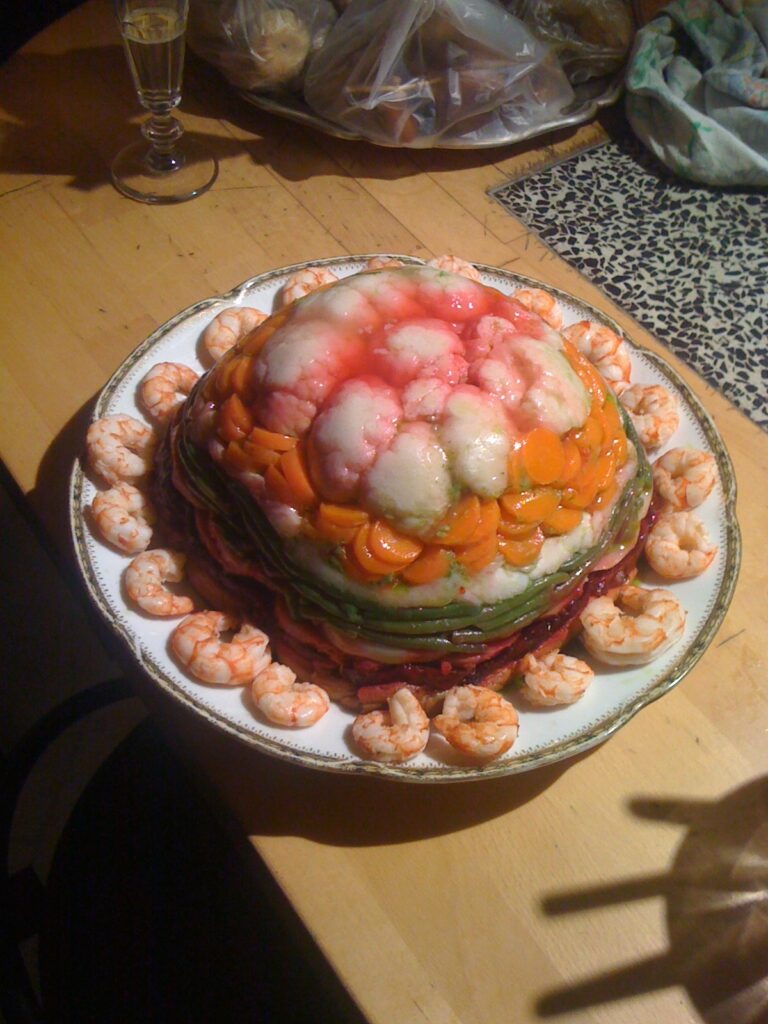
Cappon magro is the great festive dish of Genoa: a dome of boiled fish and vegetables layered over ship’s biscuits, held together by salsa verde and decorated with prawns and eggs. It is a «fast-day» dish, with no meat, and is eaten mostly on Christmas Eve and New Year’s Eve.
If you were looking for capponadda (also spelled capponada), that is a different dish: the sailors’ salad of biscuits, tomato, tuna and anchovies, with no cooking. The recipe is further down. Cappon magro is not hard, but it takes organisation: allow about 3 hours of work and at least 12 hours of resting in the fridge.
- Origin: Genoa and Liguria, a festive fast-day dish
- Total time: about 3 hours of work plus at least 12 hours resting in the fridge
- Serves: 4 people
- Difficulty: medium, for the organisation more than the technique
- Key ingredients: white fish, boiled vegetables, sailor’s biscuits, salsa verde, prawns
- When it is eaten: Christmas Eve and New Year, traditionally also on meatless days
Ingredients
For 4 people. Quantities vary from family to family and from cookbook to cookbook: this is a basic version, without the luxury shellfish.
Fish and shellfish
- 1 whole sea bream
- 400 g pink prawns
Vegetables
- 1 small cauliflower
- 1 cooked red beetroot
- 3 carrots
- 200 g green beans
- 3 artichokes
- 3 salsify roots
- carrot, celery and onion to flavour the fish water
Base and seasoning
- 4 gallette del marinaio (sailor’s biscuits) or sheets of unleavened bread
- water and white wine vinegar
- extra virgin olive oil, lemon and salt as needed
Salsa verde (Genoese green sauce)
- 1 large bunch of parsley
- 1 garlic clove (optional)
- 30 g pine nuts
- 1 slice of bread soaked in vinegar
- 1 hard-boiled egg
- 6 anchovy fillets in oil
- extra virgin olive oil and salt as needed
To decorate
- 2 hard-boiled eggs (optional)
- green olives (optional)
How to make it
- Make the salsa verde: boil the egg for 8 minutes, cool and peel it. Squeeze out the bread soaked in vinegar. Blend dry parsley, bread, egg, anchovies, pine nuts, garlic and salt, then add the oil and, if you like, a little vinegar. You can make it the day before.
- Soak the biscuits in half water, half vinegar with a pinch of salt and let them soften covered between two plates: they need at least a couple of hours.
- Prepare the vegetables: peel the carrots and salsify, cut the cauliflower into florets, trim the green beans, slice the artichokes about 3 mm thick and keep them in water and lemon.
- Cook each vegetable separately, steamed or in salted water, until tender but not soft. Dress with a little oil. Slice the beetroot thinly.
- Poach or steam the whole bream with carrot, celery and onion. Skin it, remove bones and flake it. Blanch the prawns for 2 minutes, shell them (keep a few whole for decoration) and dress fish and prawns with oil, lemon and salt.
- Line a dome-shaped mould (a pudding bowl) with cling film. Start with the beetroot at the bottom so it does not stain the rest, and alternate layers of fish and vegetables with a thin veil of salsa verde between them. Finish with the biscuits.
- Fold the film over and rest in the fridge for at least 12 hours.
- Turn the mould over onto a serving plate and remove the film. Decorate with the whole prawns, eggs and olives, and serve the leftover salsa verde on the side or over the dome.
Tips and common mistakes
- Do not overcook. Overcooked fish and vegetables lose colour and do not hold their shape. Drain them well and dress with little oil and little vinegar.
- One vegetable at a time. Each vegetable has its own timing: cook them separately and keep them al dente.
- Soften the biscuits first. The real ones take at least a couple of hours. If you cannot find them, sheets of unleavened bread layered up work too.
- Press each layer and watch the height. A dome that is too tall or too loose collapses when you turn it out.
- Keep the sauce looser than usual. The biscuits and vegetables soak it up. Tradition says mortar, but a blender is fine.
- No mayonnaise, no aspic. They are not part of the traditional version.
Food safety and allergens
It is a cold dish made ahead: work with clean hands, cook fish and prawns well and cool them quickly. Keep it in the fridge at 4–5 °C, do not leave it at room temperature for more than two hours in total (serve it straight from the fridge) and eat it within a couple of days. Festive versions also include oysters and other shellfish: eaten raw, they are not recommended for children or during pregnancy, because only cooking removes the risk of hepatitis A virus. The recipe above uses only cooked fish. Allergens: fish, crustaceans, eggs, pine nuts and gluten (biscuits).
Variations
- Festive version: with lobster, scampi, mussels and oysters. For the prawns, some recommend the red ones from Santa Margherita Ligure.
- The fish: sea bream, sea bass, hake, cod, dentex or meagre; the old recipe uses the capon fish (cappone) or red scorpionfish. In Genoa you also find octopus carpaccio.
- The vegetables: beetroot and salsify are the classic ones; the rest changes with the season. In the west there are the spiny artichokes of Albenga (Albenga typical products).
- The sauce: many recipes add capers, olives and hard egg yolks; some use pesto instead of salsa verde.
- Mosciame or bottarga: older recipes put dried tuna (mosciame) between the layers; today it is replaced with bottarga or tuna belly.
- Deconstructed or single portion: restaurants often serve it as an individual portion, easier to plate.
Capponadda: the sailors’ salad
Capponadda (also spelled capponada or caponnadda) is the «poor sister»: few ingredients, no cooking, ready quickly. It was the meal of sailors on boats; some trace it to Camogli and the fishermen of the leudi, the sailing boats used to catch anchovies. It is eaten cold, in summer. For 4 people:
- 4 gallette del marinaio (sailor’s biscuits)
- 2 beefsteak tomatoes (or 8 cherry tomatoes)
- 12 anchovy fillets in oil
- 180 g tuna in oil
- 40 g Taggiasca olives
- 20 g capers
- 1 garlic clove or 1 red onion
- extra virgin olive oil, salt, vinegar, water and basil or oregano as needed
Rub the biscuits with garlic (if using onion, slice it thinly) and soften them in a little water and vinegar. Break them into a bowl and add chopped tomatoes, anchovies, flaked tuna, olives and capers. Dress with oil, salt and basil or oregano and rest for 1 to 3-4 hours, stirring before serving. In the La Spezia version thyme replaces basil.
History and origin

Cappon magro was originally a poor dish: leftover fish and vegetables for fishermen and for servants, who reused the remains of noble banquets. It became richer and more theatrical in the Baroque period, with sauces, prawns and eggs.
There are several ideas about the name. «Magro» means days of penance and Lent, when meat was not eaten. «Cappone» may point to the capon fish or, ironically, to the real capon the dish replaced; another idea derives it from the dry bread base, like the French chapon. It has nothing to do with caponata. Today it is eaten at Christmas and New Year, and also at weddings and special occasions.
Where to try it in Liguria
The city of cappon magro is Genoa: many restaurants serve it all year, often as a single portion. For the holidays it is wise to ask delicatessens well in advance, because the dish takes a day of work. More ideas at the table in what to eat in Genoa. We name no restaurants: menus change, so check the restaurant’s website. Capponadda is eaten mostly in the east, in Camogli and Chiavari. For the rest of the Ligurian table see Ligurian food, Genoese basil sauce (pesto), pansoti with walnut sauce and torta pasqualina.
What to drink
A fresh Ligurian white goes well with fish and salsa verde, for example a Vermentino or a Pigato from the Riviera Ligure di Ponente. This is our suggestion, not a rule of tradition. More wines in Ligurian wines.
Frequently asked questions
What is cappon magro?
It is a Ligurian dish of boiled fish and vegetables, layered over sailor’s biscuits with salsa verde. It contains no meat and is eaten mostly at Christmas and New Year.
What is the difference between cappon magro and capponadda?
Cappon magro is a festive dish, cooked and built into a dome. Capponadda is the sailors’ salad of biscuits, tomato, tuna and anchovies, with no cooking.
When is cappon magro eaten?
Mostly on Christmas Eve and New Year. Traditionally it was also eaten on meatless days such as Lent.
Can I make it ahead?
Yes, in fact you have to: it rests in the fridge for at least 12 hours and the salsa verde can be made the day before. Keep it at 4–5 °C and eat it within a couple of days.
Which fish is used?
Firm white fish: sea bream, sea bass, hake, dentex. The «cappone» of the old recipe is a fish, not a chicken.
Where do I find gallette del marinaio?
They are the dry Ligurian ship’s biscuits. If you cannot find them, use layered sheets of unleavened bread.
Can I make it without lobster and oysters?
Yes. The basic version uses fish and prawns; lobster, scampi and oysters are festive extras.