Riviera di Ponente › Riviera delle Palme
Castelbianco
Colletta, the telematic village, Veravo and Vesallo: churches, castle ruins, trails and climbing in the Val Pennavaire. 17 km from…
Discover →
The story of Colletta: the depopulated stone village, Giancarlo De Carlo's restoration, fibre optics, how to visit and where to stay.
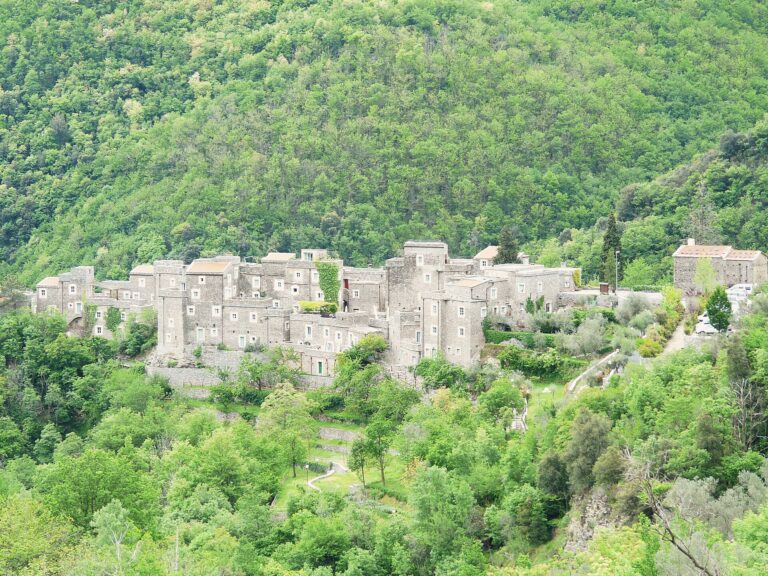
Colletta di Castelbianco is a stone village in the Val Pennavaire, almost empty for decades, restored in the 1990s to a design by Giancarlo De Carlo and given a fibre-optic network for people working remotely: that is why it is known as the “telematic village”. It is a hamlet of the municipality of Castelbianco, in the hinterland of Albenga.

The village is built entirely of stone and is thought to date from the 13th century, perhaps as a defence against the Saracens, on the road linking Albenga with Piedmont. The area is documented from 1202 as a fief of the Clavesana marquises; it then passed to the Del Carretto of the Finale branch and to the marquisate of Zuccarello. Around the middle of the 19th century the village reached its peak population.
Then came the decline. According to several guides the decisive blow was the 1887 earthquake, which damaged Colletta in particular and made many inhabitants leave. Other sources place the abandonment later: English-language Wikipedia and Wikivoyage speak of the 1950s, while a 2025 article says that only five residents were left in the 1971 census. The dates do not match, but the picture is the same: by the early 1990s Colletta was largely uninhabited and in ruins.

The restoration was entrusted to Giancarlo De Carlo, the architect who had worked on the historic centre of Urbino. The years vary by source: one guide says the village was bought in 1990 by the company Sivim, a 2025 article speaks of entrepreneurs who bought it in 1995; the project archive of the Iuav University of Venice dates the work 1994–98. Either way, buying up the properties, often owned by people who had emigrated, took years.
The plan did not change the shape of the village: same lanes, same stone, same volumes. The grey stone houses, coloured doors and white-framed windows you see today are the result of the restoration. The number of dwellings varies from source to source, between about sixty and seventy.
The second track of the project was technological. The telematics plan was devised by Valerio Saggini and designed with Stefania Belloni. Every house received fibre optics, a private digital telephone exchange, a fax server, an intranet, a centralised satellite system and interactive television. The idea, inspired by American “televillages”, was to let people live in the quiet of a village while staying connected to work. Today Colletta is above all a place for holidays and long stays.

You visit on foot. The village is lived in and many houses are private: walk the lanes and do not enter courtyards. In the upper part are the chapel and oratory of Santa Lucia and a few medieval bridges. In the village, according to the guides, there are a pool, a coin-operated laundry, a small shop and a library; a restaurant with a terrace and a bar are on the square. These services are meant mainly for guests: opening and hours are not confirmed ⚠️.
Two marked trails start from Colletta: the yellow route, about 1.5 km, easy, and the red loop, about 7.5 km, of medium difficulty (see the guide to Castelbianco). Near the village there are also some crags of the Val Pennavaire.
Colletta works as an albergo diffuso: flats made from the village’s houses, owned by Italians and foreigners, let for short or long periods, with a panoramic pool and on-site reception. You sleep in silence, but with no sea (Albenga is about 17 km away) and few places open in the evening. The village’s own site is colletta.it: prices and availability must be asked there ⚠️.
Nearby
Riviera di Ponente › Riviera delle Palme
Colletta, the telematic village, Veravo and Vesallo: churches, castle ruins, trails and climbing in the Val Pennavaire. 17 km from…
Discover →Guide
The weather in Castelbianco today, tomorrow and for the next 10 days: hourly forecast, wind, rain and the climate month…
Discover →